Brine Concentration Is Redefining the Value of RO Membranes
For the past decade, the competitive narrative in reverse osmosis membranes has centered on salt rejection. 99.5%, 99.7%, 99.8%—every incremental gain past the decimal point was presented as proof of technical capability. But what is genuinely changing project economics in 2026 is not another fraction of a percent in rejection. It is how concentrated a membrane system can push the brine.
DuPont's April 2026 expansion of the FilmTec Fortilife XC series sends a clear signal. The XC-Max UHP element can concentrate brine to 250 g/L as NaCl at operating pressures up to 120 bar; the XC220 reaches 220 g/L at 83 bar. DuPont's positioning is explicit: this capability extends membrane technology into operating regimes traditionally dominated by thermal processes, allowing the feed volume to the final evaporation step in conventional ZLD systems to be significantly reduced, and potentially bypassing evaporation altogether.
This is not an isolated product iteration. On a parallel timeline, Toray's TSW-K/M/V series seawater membranes will launch commercially in October, with salt permeability up to 55% lower than existing models, making the shift from two-pass to single-pass RO in new seawater desalination projects a commercially orderable reality. Both developments point in the same direction: membrane elements are evolving from standardized filtration units into tools that define process boundaries.
For system designers and operators, this means the specification logic needs to adjust. Salt rejection and flux alone are no longer sufficient. The relevant questions now are: where does this element's actual operating boundary sit at your target brine concentration? Are the high-pressure pump, energy recovery device, and concentrate-side antiscalant strategy properly matched? Is there long-term data on the mechanical integrity of the element under ultra-high-pressure operation?
Market data reinforces this shift. Thin-film composite membranes held 81.90% of the RO membrane market in 2025, and their dominance is not in question. But the same market analysis notes that membrane elements account for 35–45% of total RO system operating expenditure, with 8-inch spiral elements priced around USD 300 per unit. Budget-sensitive operators sometimes extend element life beyond manufacturer recommendations, trading higher energy consumption for lower near-term capital expenditure. This practice may be understandable under cash flow constraints, but it is not economically sound at the system level—especially when brine concentration targets rise and membrane elements operate under more demanding conditions, where the cost of premature failure far exceeds the purchase price difference.
Regulatory change in Europe is also increasing the weight of membrane technology in application scenarios. In the regulatory amendment notified by France to the EU in January 2026, ANSES formally recognized the retention effectiveness of nanofiltration and reverse osmosis membranes for pesticide metabolites and PFAS, allowing such membrane products to enter the market directly without case-by-case evaluation. This means the compliance pathway for membrane technology in European drinking water projects addressing micropollutants is simplifying, and the technical threshold at specification is shifting from "can it be used" to "which element fits better."
Returning to the procurement decision itself. The question worth asking at this stage is no longer "what is the salt rejection of this membrane," but: what is its actual flux decline curve at your target brine concentration? How does the cleaning interval change under ultra-high-pressure conditions? Are there reference engineering cases for the balance-of-plant configuration?
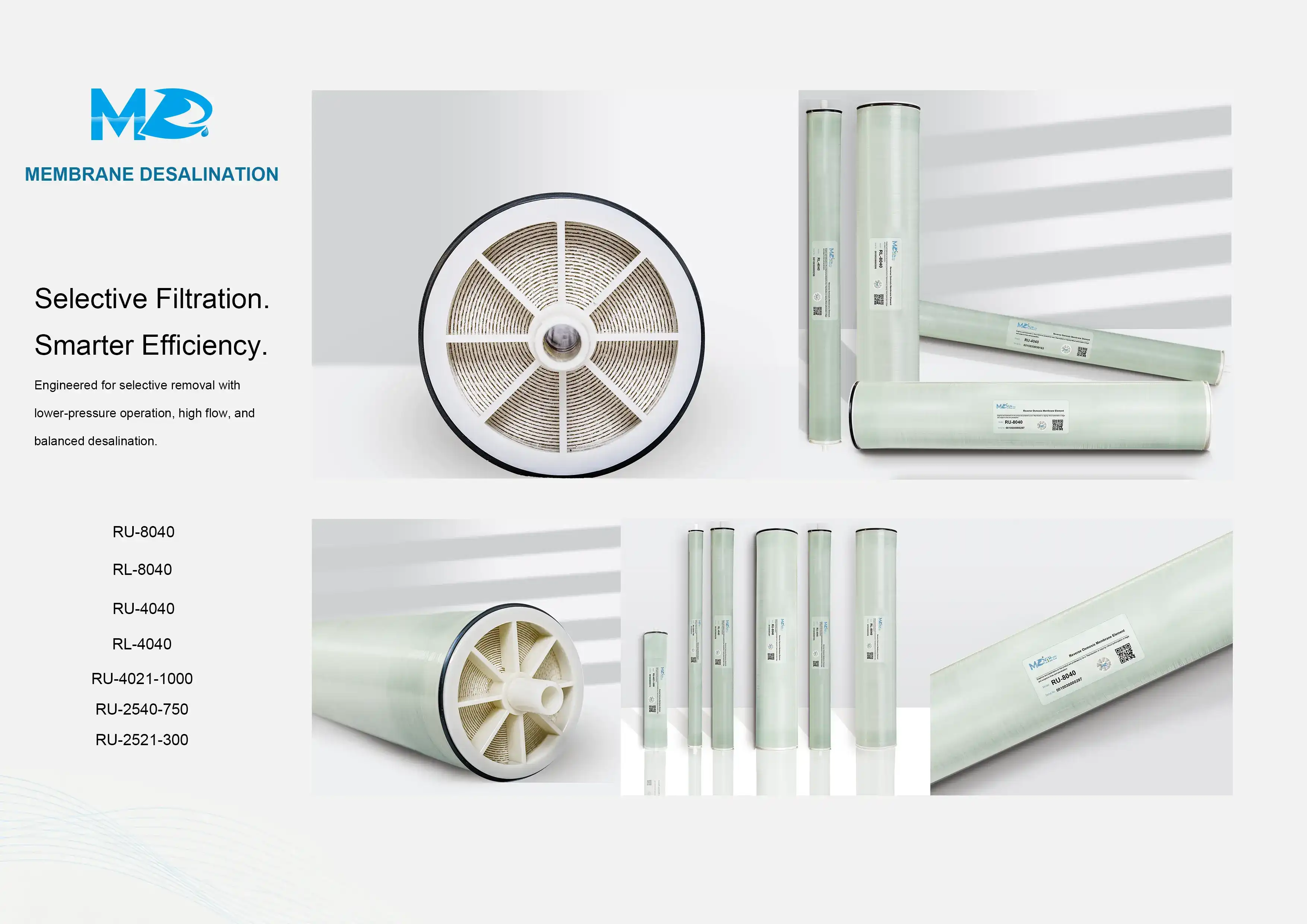
Xi'an Membrane Desalination International Co., LTD. supplies industrial-grade and seawater desalination RO membrane elements, with OEM and ODM support, complete testing capabilities, and a fast delivery system. For membrane selection discussions specific to your brine concentration target or process scenario, contact us: