Can ro membrane be cleaned ?
Can You Clean an RO Membrane? Effectiveness, Methods and Best Practices
Understanding whether an RO membrane can be cleaned — and how — is central to keeping a reverse osmosis system efficient over its service life. This guide covers what cleaning can and cannot fix, the chemicals that are safe to use, and the maintenance practices that reduce how often cleaning is needed.
Is Cleaning Effective for All Types of RO Membranes?
Cleaning a membrane can significantly extend its service life and restore performance, but not all membranes respond the same way. The outcome depends on three things: the type of fouling or scaling, the cleaning chemistry used, and the membrane's own material and condition.
Different foulants require different approaches. Organic and biological fouling is normally treated with alkaline cleaning solutions, while inorganic scaling such as calcium carbonate responds to acidic cleaners. Using the wrong chemistry can worsen the problem rather than fix it. Always work within the membrane manufacturer's stated pH and temperature limits, and remember that cleaning restores performance that has drifted — it cannot reverse chemical damage such as oxidation by chlorine, which is permanent.
What Are the Best Practices for RO Membrane Maintenance?
Maintenance for an RO membrane is mostly about prevention and early detection.
Regular monitoring. Track normalized permeate flow, pressure differential and salt rejection against the baseline recorded when the element was new. Trends matter more than single readings.
Correct pretreatment. Feed water pretreatment reduces the load reaching the membrane. Sediment filtration, activated carbon and water softening each address a different problem — and activated carbon is what protects a polyamide membrane from free chlorine, which causes irreversible damage at levels above 0.1 ppm.
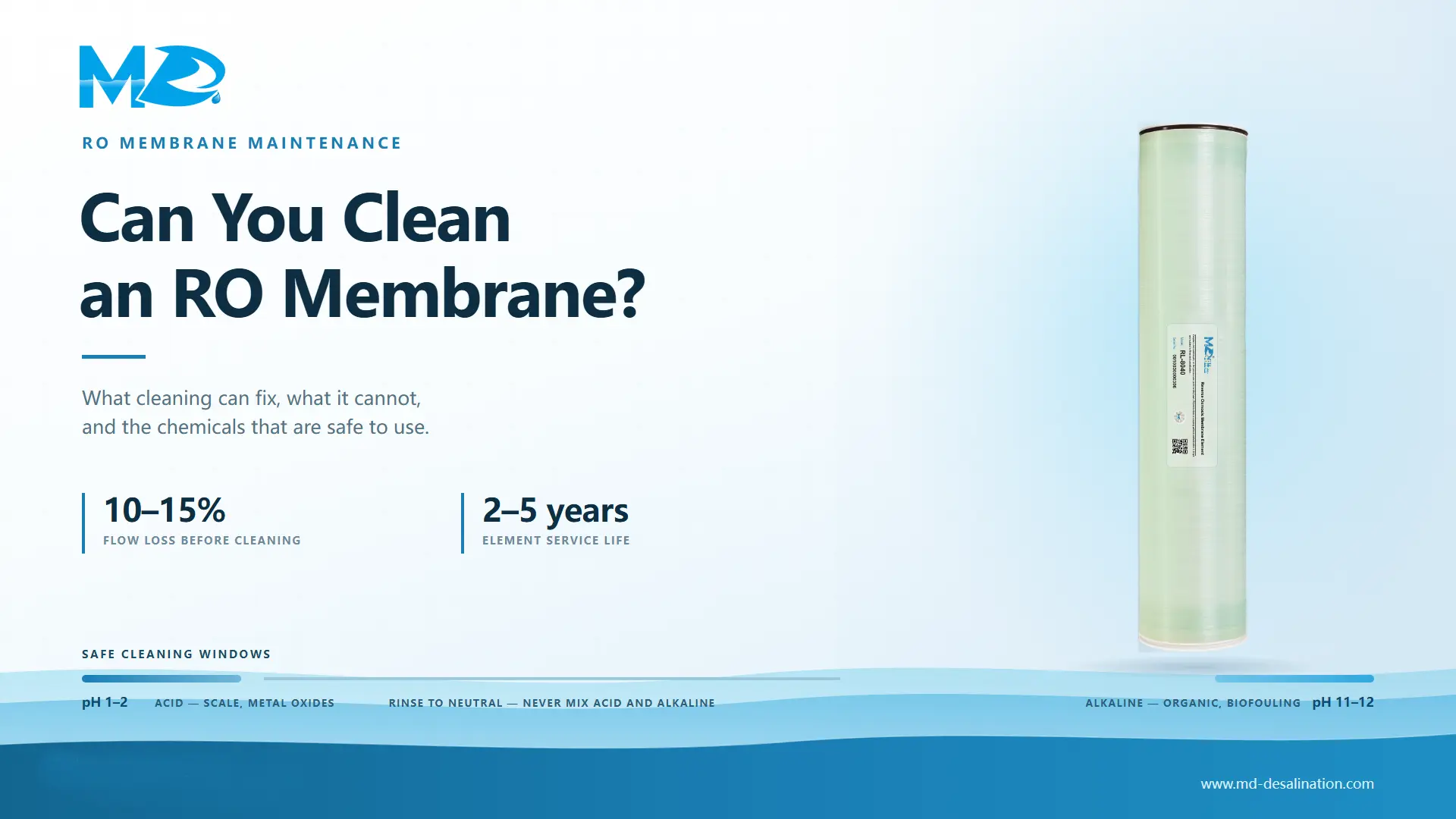
Cleaning based on performance, not the calendar. Clean when normalized flow drops by 10–15%, pressure differential rises by 10–15%, or salt rejection falls noticeably. Scheduled cleaning regardless of condition wastes chemicals and can shorten membrane life.
Keep records. Log cleaning dates, chemicals used, and performance before and after each clean. This is the only way to tell whether a cleaning procedure is actually working.
What Chemicals Are Safe to Use for Cleaning?
Alkaline cleaners, typically pH 11–12, remove organic fouling and biofouling.
Acid cleaners, typically pH 1–2, remove inorganic scale such as calcium carbonate and metal oxides, and are also used to remove iron and manganese deposits.
Biocides control microbial growth on the membrane surface and in the feed spacers, and must be compatible with the membrane material and permitted for the application.
Chelating agents and surfactants are often included in commercial formulations to help dissolve precipitates and lift foulants off the surface.
Use only chemicals specified for RO membranes, at the pH and temperature limits the manufacturer states, and handle and dispose of cleaning solutions according to local regulations. Never mix an acidic and an alkaline cleaner directly — the reaction generates heat and gas.
How Can I Ensure Long-Term Performance of My RO Membrane?
Protect the feed water. The single biggest factor in membrane life is what reaches the membrane. Adequate pretreatment and, where required, antiscalant dosing prevent most fouling problems before they start.
Operate within design parameters. Respect the pressure, temperature, recovery and pH limits, and avoid frequent start-stop cycling, which accelerates mechanical stress.
Clean correctly and early. Treat a fouling problem when the performance shift is small. Fouling that has been allowed to compact or age is far harder to remove.
Replace on evidence, not on a schedule. Replace an element when cleaning no longer restores acceptable performance, when the element is near the end of its service life — typically two to five years — or when it has suffered physical damage.
FAQ
Q: How often should I clean my RO membrane?
A: Base the decision on measured performance rather than a fixed interval. Clean when normalized permeate flow has dropped by 10–15%, pressure differential has risen by 10–15%, or salt rejection has declined. In practice this may mean quarterly cleaning in demanding applications such as seawater desalination, or once or twice a year in clean, well-pretreated systems.
Q: Can I use household cleaning products to clean my RO membrane?
A: No. Household cleaners are not formulated for polyamide composite membranes and can cause permanent damage. Use cleaning chemicals specified for RO membranes, at the pH and temperature limits stated by the manufacturer.
Q: What are the signs that my RO membrane needs cleaning?
A: Reduced permeate flow, increased pressure differential, and declining salt rejection — all measured against baseline performance. Changes in water quality or taste support the diagnosis but should not be used on their own.
Q: Can cleaning restore a membrane that has lost rejection permanently?
A: No. Cleaning removes foulants and restores lost flow or rejection caused by deposits. It cannot reverse chemical degradation, such as oxidation from chlorine exposure, or physical damage to the membrane surface. Those cases require replacement.
Conclusion
Cleaning an RO membrane is a maintenance action, not a cure. It works when the fouling type is identified correctly, the right chemistry is used within the membrane's limits, and the decision to clean is driven by performance data. Combined with proper pretreatment and monitoring, that approach keeps an RO system producing consistent water and extends the life of each element.
MD Desalination is a manufacturer and supplier of RO membrane elements, offering OEM and ODM services for domestic, commercial, industrial, and seawater applications. We maintain large inventory, hold complete product certifications, support sample testing, and ship with strict packaging controls. To discuss your membrane requirements, contact us at info@md-desalination.com.