Can ro membrane connect directly to filter?
Can an RO Membrane Connect Directly to a Filter?
An RO membrane cannot be connected directly to a filter. In a reverse osmosis system the membrane element sits inside a pressure vessel and connects to the plumbing through end caps, interconnectors and O-rings, while filters are installed upstream in the pretreatment train, ahead of the high-pressure pump. The two components serve different purposes at different points in the flow path, and the order in which they are arranged determines how long the membrane lasts.
How the Components Are Arranged
An RO system is a sequence, not a set of interchangeable parts. Feed water passes through pretreatment first, then reaches the membrane, and the membrane does the actual dissolved-solids removal.
The membrane is a semi-permeable barrier that rejects dissolved salts, heavy metals, organic compounds, bacteria and viruses. It is installed inside a pressure vessel, and elements are joined to each other and to the manifold with interconnectors and O-rings.
Filters remove what the membrane should never have to deal with: suspended solids, turbidity, chlorine and other oxidants. They are installed before the pump, not after it.
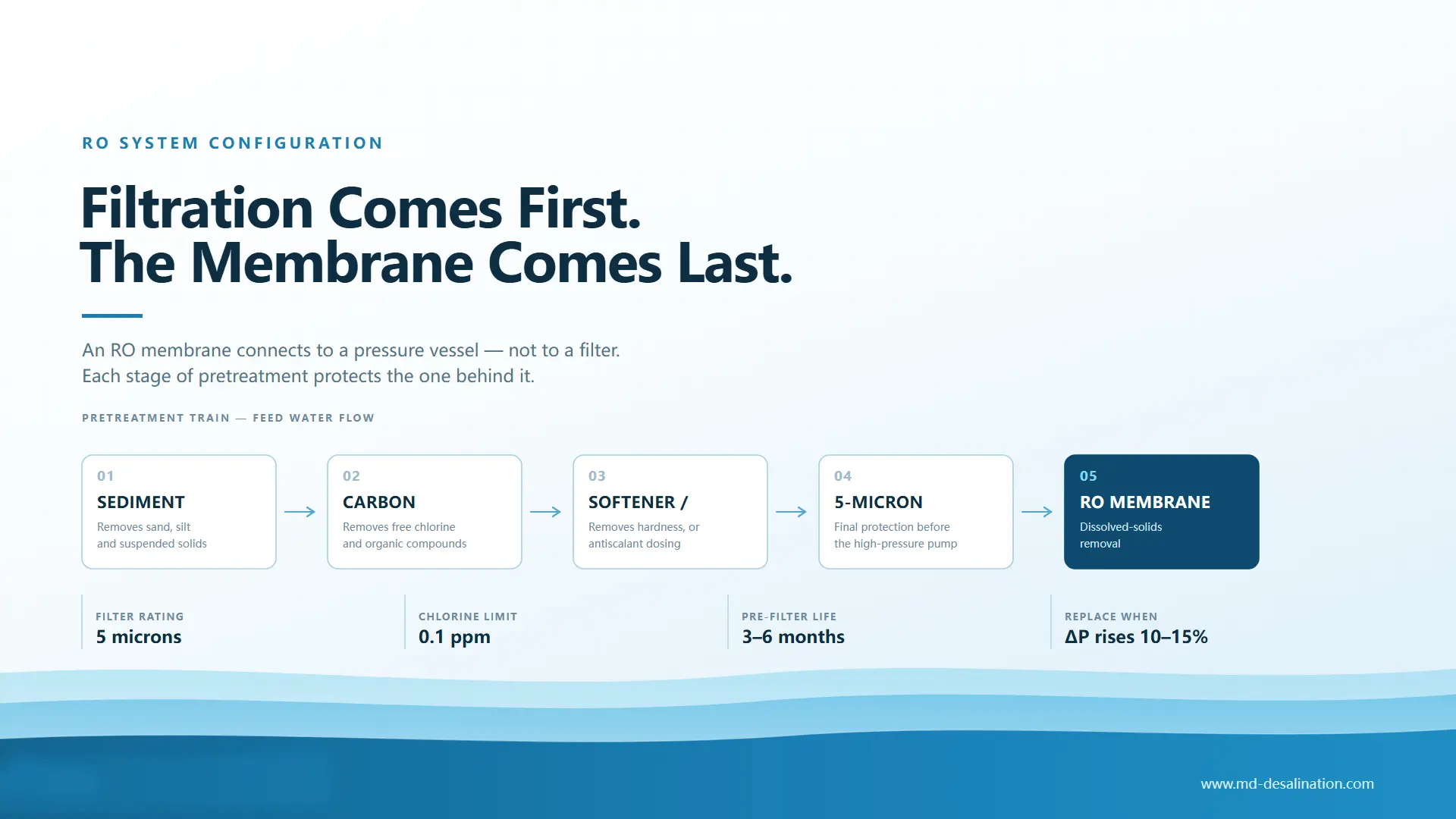
A typical pretreatment train runs sediment filtration, then carbon filtration, then — where the feed water requires it — water softening or antiscalant dosing, followed by a final 5-micron cartridge filter before the high-pressure pump. This order is deliberate: each stage protects the one behind it.
Why Carbon Pretreatment Matters Most
The single most important pre-filter function is not sediment removal — it is chlorine removal.
Polyamide composite membranes, which account for virtually all modern RO elements, are sensitive to oxidants. Free chlorine in the feed water attacks the active layer and permanently degrades salt rejection. The limit is typically 0.1 ppm, and the damage is irreversible: once a membrane has been oxidised, no amount of cleaning will restore it.
This is why carbon filtration is not optional in most municipal-water applications. It is also why a carbon pre-filter must be replaced on schedule — a spent carbon filter stops removing chlorine while still passing water, which means the membrane is being damaged without any obvious sign until rejection starts to fall.
Recommended Pre-Filters
Sediment filters capture sand, silt, rust and other suspended particles. Cartridge ratings of 5 microns are typical ahead of an RO membrane.
Carbon filters remove free chlorine, chloramine (with the appropriate media) and organic compounds, and also improve taste and odour.
Water softeners remove hardness minerals that would otherwise form scale on the membrane surface, and are used where the feed water is hard.
Antiscalant dosing is an alternative or complement to softening, particularly in larger systems, preventing precipitation of sparingly soluble salts.
Selection depends on the feed water analysis. A system running on municipal supply has different pretreatment requirements from one running on brackish well water or seawater.
How Often Pre-Filters Need Replacing
Replacement intervals depend on the filter type, the feed water and the duty cycle, so a fixed schedule should be treated as a starting point:
-
Sediment and 5-micron cartridge filters are commonly changed every 3 to 6 months, or sooner where turbidity is high.
-
Carbon filters are typically changed every 6 to 12 months.
-
The most reliable trigger is pressure differential. Replace a cartridge filter when the pressure drop across it rises by 10–15% above its clean value, or when it reaches the manufacturer's stated limit. Waiting for a fixed date can mean running a spent filter for weeks.
If Pre-Filters Are Skipped
Operating a membrane without adequate pretreatment has predictable consequences:
Accelerated fouling. Suspended solids and organics reach the membrane surface, raising pressure differential and reducing permeate flow.
Irreversible oxidation. Without carbon, chlorine reaches the membrane and permanently lowers salt rejection.
Scaling. Without softening or antiscalant dosing, hardness salts precipitate on the membrane surface and in the feed spacers.
Higher operating cost. Fouling increases pump energy demand and cleaning frequency, and the shortened service life means earlier replacement.
FAQ
Q: Can I connect an RO membrane directly to a filter?
A: No. The membrane element is installed in a pressure vessel and connected through end caps and interconnectors. Filters belong upstream in the pretreatment train, ahead of the high-pressure pump. Connecting them in any other order either bypasses the protection the membrane needs or puts the filter in a position where it serves no purpose.
Q: What types of pre-filters are recommended?
A: Sediment filtration to remove suspended solids, carbon filtration to remove free chlorine and organics, and — where the feed water is hard or high in scaling potential — a water softener or antiscalant dosing. A 5-micron cartridge filter is commonly used immediately before the high-pressure pump.
Q: How often should pre-filters be replaced?
A: Sediment and cartridge filters typically every 3 to 6 months, carbon filters every 6 to 12 months. Because the correct interval depends on feed water quality, replacement should also be triggered by a 10–15% rise in pressure differential across the filter.
Q: What happens if I skip pre-filtration?
A: Suspended solids foul the membrane, chlorine oxidises the active layer irreversibly, and hardness salts scale the surface. The result is falling permeate flow, declining salt rejection, more frequent cleaning, higher energy consumption and a shorter membrane service life.
Conclusion
An RO membrane is not connected to a filter; it is connected to a pressure vessel, and the filter protects it from upstream. Keeping the pretreatment train in the correct order — sediment, carbon, softening or antiscalant, and a final cartridge filter — is what allows a membrane to reach its expected service life. The most common cause of premature membrane failure is not a defective element but inadequate pretreatment ahead of it.
MD Desalination is a manufacturer and supplier of RO membrane elements, offering OEM and ODM services for domestic, commercial, industrial, and seawater applications. We maintain large inventory, hold complete product certifications, support sample testing, and ship with strict packaging controls. To discuss your membrane requirements, contact us at info@md-desalination.com.