How does ro membrane work?
How Does an RO Membrane Work?
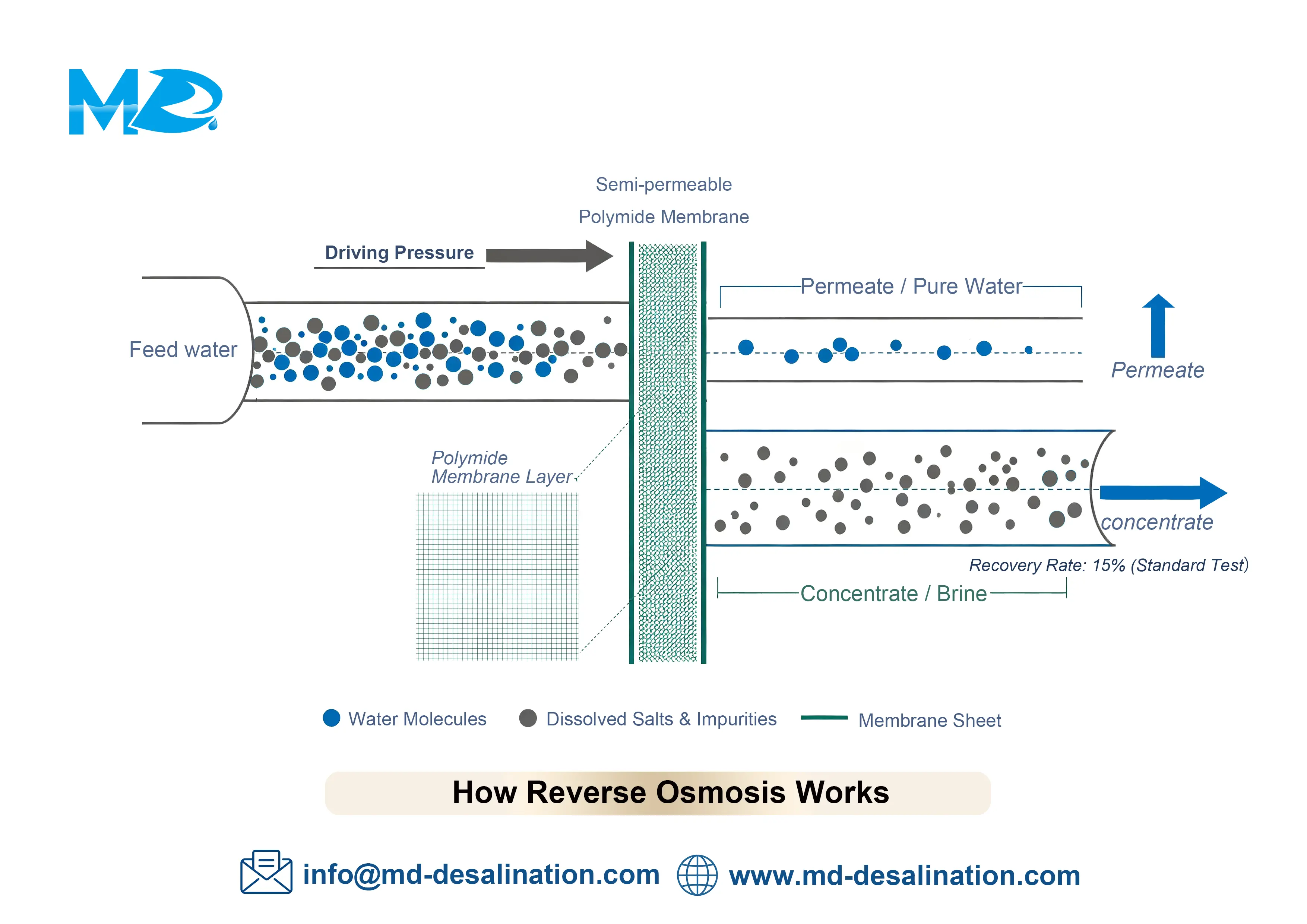
Reverse osmosis (RO) is a widely used water purification technology, and the membrane is the core component of the process. Understanding how an RO membrane works matters to anyone involved in water treatment, from large industrial plants to household purification systems.In RO, feed water is pressurized above its osmotic pressure and forced against a semi-permeable membrane. The membrane allows water molecules to pass while rejecting dissolved salts, organic matter, bacteria, and other contaminants. The portion that passes through is called permeate; the portion that carries the rejected contaminants away is called concentrate or reject.
Reverse osmosis takes its name from the fact that it reverses the natural process of osmosis. Under normal conditions, water moves from a dilute solution toward a concentrated one. Applying pressure greater than the osmotic pressure of the feed water reverses that direction, so water is driven out of the concentrated stream instead of into it.
Separation takes place through two mechanisms. Size exclusion prevents larger particles and ions from passing through the tightly packed polymer matrix of the membrane. Electrostatic interaction the membrane surface carries a negative charge - repels dissolved ions, particularly multivalent ions such as calcium and sulfate. Together these mechanisms allow the permeate to be produced substantially free of the contaminants present in the feed water.
Benefits of RO Membranes
Effective contaminant removal. RO membranes remove dissolved salts, minerals, heavy metals, organic compounds, bacteria, and viruses, and they improve the taste and clarity of the treated water.
Consistent water quality for industrial use. Manufacturing, pharmaceutical production, and semiconductor fabrication all depend on water that meets strict purity specifications. RO provides that consistency as a reliable pretreatment or primary purification step.
Desalination capability. RO makes seawater and brackish water usable, which is why it is central to water supply in regions with limited freshwater resources.
Lower chemical consumption. Compared with some alternative treatment methods, RO achieves high purity with less reliance on chemical dosing.
Quality Assurance
For buyers, the key question is whether a membrane performs to specification. Our elements are tested against defined performance criteria — flow, salt rejection, and integrity — before shipment, and test data can be supplied with the order. If your project requires documented verification, samples are available for evaluation before you commit to volume.
Durability and Lifespan
RO membranes are engineered for continuous operation. Construction quality — the flat sheet, the feed spacer, the permeate tube, and the glue lines — determines how well an element holds up under pressure cycling, cleaning, and fouling. Elements operated within design parameters and maintained correctly typically last two to five years in service, although feed water quality and pretreatment have the greatest influence on actual lifespan.
Cost-Effectiveness
The relevant figure is not the purchase price of one element but the cost per cubic meter of treated water over its service life. A membrane that holds its rejection rate and flow longer, and needs cleaning less often, usually costs less to operate than a cheaper element that fails early and interrupts production.
Customization and Support
For non-standard applications or specific water quality requirements, OEM and ODM services are available. We support custom specifications and provide technical support through selection, commissioning, and troubleshooting.
FAQ
What contaminants can an RO membrane remove?
Dissolved salts, heavy metals, organic compounds, bacteria, and viruses. RO is particularly effective at removing dissolved solids and produces high-purity permeate.
How often should an RO membrane be replaced?
Most elements last between two and five years, depending on feed water quality, pretreatment, and system usage. Replacement should be based on measured performance rather than on a fixed schedule.
Can RO membranes be used for desalination?
Yes. RO is the dominant desalination technology for converting seawater and brackish water into potable water, and seawater elements are specifically engineered for the higher pressures and corrosive conditions involved.
Conclusion
Understanding how an RO membrane works — and what determines its performance over time — helps you select the right element and operate it properly.
MD Desalination is a manufacturer and supplier of RO membrane elements, offering OEM and ODM services for domestic, commercial, industrial, and seawater applications. We maintain large inventory, hold complete product certifications, support sample testing, and ship with strict packaging controls. To discuss your membrane requirements, contact us at info@md-desalination.com.