How often replace ro membrane?
The Importance of RO Membrane Replacement
To preserve the performance and service life of your reverse osmosis (RO) system, it is vital to understand when to replace the RO membrane. This component is the heart of water purification, as it filters out contaminants to produce safe, clean water. Even so, the RO membrane, just like any other part, has a finite service life and requires routine replacement to maintain optimal operating performance.
MD Desalination (Xi'an Membrane Desalination International Co., Ltd.) is a manufacturer and supplier of RO membrane elements, offering OEM and ODM services for domestic, commercial, industrial, and seawater applications. Contact us at info@md-desalination.com to discuss your membrane requirements. Free evaluation samples are available on request.
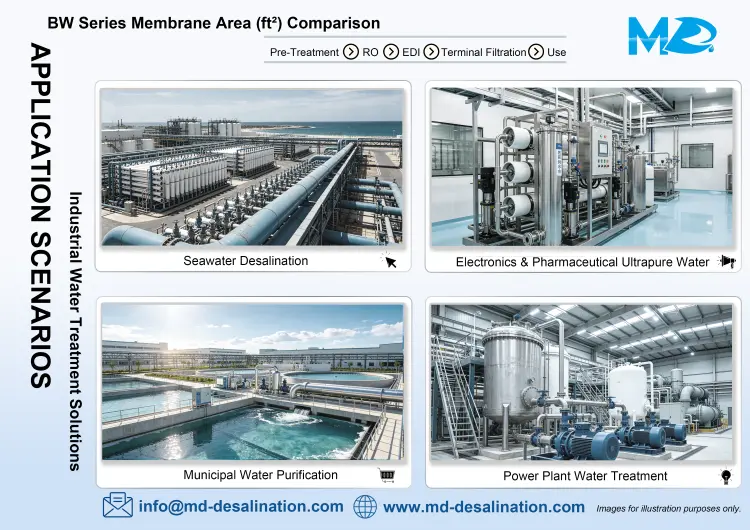
Understanding RO Membrane Lifespan
The service life of a reverse osmosis (RO) membrane depends on several factors, including feed water quality, operating conditions, and how well the system is maintained. In most applications, an RO membrane element lasts between 2 and 5 years. Actual lifespan varies by application: household systems typically run 2–3 years, industrial systems 3–5 years, and seawater desalination systems often 1–3 years because of higher operating pressures and more corrosive feed water.
-
Water Quality : Membranes foul faster when feed water contains high levels of suspended solids, organics, or total dissolved solids (TDS). Free chlorine is especially damaging — polyamide composite membranes are sensitive to oxidants, and chlorine levels above 0.1 ppm cause irreversible damage to the membrane surface.
-
Usage : Higher daily output means the membrane works harder and degrades sooner.
-
Maintenance : Regular pre-filter replacement and system sanitization extend membrane life. Timely cleaning-in-place (CIP) also helps restore performance when fouling is detected early.
-
Operating Conditions :Lower feed water temperature reduces permeate flow; frequent start-stop cycles accelerate mechanical stress. Both shorten service life.
Signs Your RO Membrane Needs Replacement
Knowing when to replace an RO membrane keeps your system performing reliably and protects water quality. The following signs indicate that a membrane element may be reaching the end of its service life.
Decreased Permeate Flow. A significant drop in purified water output usually points to fouling, scaling, or compaction of the membrane. Compare current flow against the system's baseline performance, measured under the same temperature and pressure conditions.
Higher TDS in Permeate. Regularly testing the TDS level of your product water is the most practical way to track membrane condition. Use a meter with automatic temperature compensation (ATC), since TDS readings vary with water temperature. A steady upward trend in permeate TDS indicates that the membrane is no longer rejecting dissolved solids as effectively as it should.
Lower Salt Rejection Rate. A decline of 10% or more in salt rejection, or permeate TDS rising above the system's design limit, means the membrane has lost separation performance.
Increased Pressure Differential. A rise in the pressure difference between feed and concentrate — typically 15% or more above baseline — indicates fouling or channel blockage and often precedes a drop in flow.
Changes in Water Quality. If your water tastes, smells, or looks unusual, the membrane may no longer be removing contaminants as it once did. This should be checked together with TDS and flow data rather than treated as a single indicator.
Customer Concerns about ro Membranes
How long does a membrane last, and is it cost-effective?
Most RO membrane elements last between 2 and 5 years, but the actual figure depends on feed water quality, operating conditions, and maintenance. A membrane that is matched to the application and maintained properly delivers consistent water quality over a longer period, which lowers the cost per cubic meter of treated water and reduces how often elements must be replaced. Choosing a membrane by specification rather than by price alone is usually the more economical decision over the life of the system.
Will a new membrane be compatible with my existing system?
RO membrane elements are manufactured to standard industry dimensions — 1812, 2012, 2540, 3013, 4040, and 8040 — so compatibility mainly depends on matching the element size, end configuration, and performance rating to your system's design.MD Desalination provides detailed specifications for each element so you can verify the match before ordering. Custom configurations are also available for non-standard requirements.
How difficult is installation and maintenance?
Element replacement follows a straightforward procedure: isolate the system, depressurize, remove the used element, lubricate the O-rings, and seat the new element fully into the pressure vessel. Keeping a record of baseline flow, TDS, and pressure data after installation makes it easier to detect performance changes later. MD Desalination supplies installation guidance and maintenance instructions with its membranes, and our technical team is available to support troubleshooting.
What is the environmental impact?
The most effective way to reduce the environmental footprint of an RO system is to extend membrane service life. A membrane that is protected by proper pretreatment, cleaned at the right time, and operated within its design parameters needs replacement less often, which means fewer discarded elements and less downtime. Responsible maintenance is therefore both an operational and an environmental decision.
FAQ
Q: How often should I replace my RO membrane?
A: In most applications, every two to five years, depending on feed water quality, usage, and maintenance. Seawater desalination systems often require more frequent replacement because of higher operating pressures and more corrosive feed water.
Q: How can I tell whether my RO membrane needs replacement?
A: The main indicators are declining permeate flow, rising permeate TDS, a drop of 10% or more in salt rejection, and an increase in the pressure differential between feed and concentrate. Changes in taste, odor, or appearance should be checked alongside these measurements rather than used on their own.
Q: Can I install an RO membrane myself?
A: Yes. Element replacement is a straightforward procedure, and MD Desalination supplies installation instructions with every membrane. Our technical team is available to answer questions during installation or commissioning.
Q: Are your RO membranes compatible with all systems?
A: RO membrane elements are built to standard industry dimensions, so compatibility depends mainly on matching element size, end configuration, and performance rating to your system. MD Desalination offers a range of elements covering domestic, commercial, industrial, and seawater applications, and we can review your system specifications to confirm the right model before you order.
Conclusion
RO membrane replacement is part of keeping a reverse osmosis system efficient over its service life. Understanding the factors that affect membrane lifespan — feed water quality, operating conditions, usage, and maintenance — makes it easier to recognize when an element is reaching the end of its useful life and to plan replacement before water quality deteriorates. Monitoring permeate flow, TDS, and pressure data on a regular basis is the most reliable way to make that decision.
MD Desalination is a manufacturer and supplier of RO membrane elements, offering OEM and ODM services for domestic, commercial, industrial, and seawater applications. We maintain large inventory, hold complete product certifications, and support sample testing before you commit to an order. To discuss your membrane requirements, contact us at info@md-desalination.com.
Reference
1.DIY RO Membrane Installation: A Step-by-Step Guide." Home Water Treatment Solutions, 3rd ed., 2022.
2.Compatibility of RO Membranes in Diverse Water Systems." International Journal of Water Supply and Management, vol. 12, no. 1, 2021, pp. 55-65.
3.The Impact of Membrane Replacement on the Efficiency of Reverse Osmosis Systems." Environmental Engineering Science, vol. 36, no. 2, 2020, pp. 123-131.