Three Trends Reshaping RO Membrane Selection in 2026
The reverse osmosis membrane industry is undergoing a structural shift. The competitive differentiator is no longer a marginal improvement in salt rejection—it is whether a membrane platform can adapt to three converging pressures: seawater desalination process intensification, regulatory-driven PFAS removal, and the transition from passive to active fouling control. For system operators and procurement teams, understanding these shifts is now a prerequisite for specification decisions.
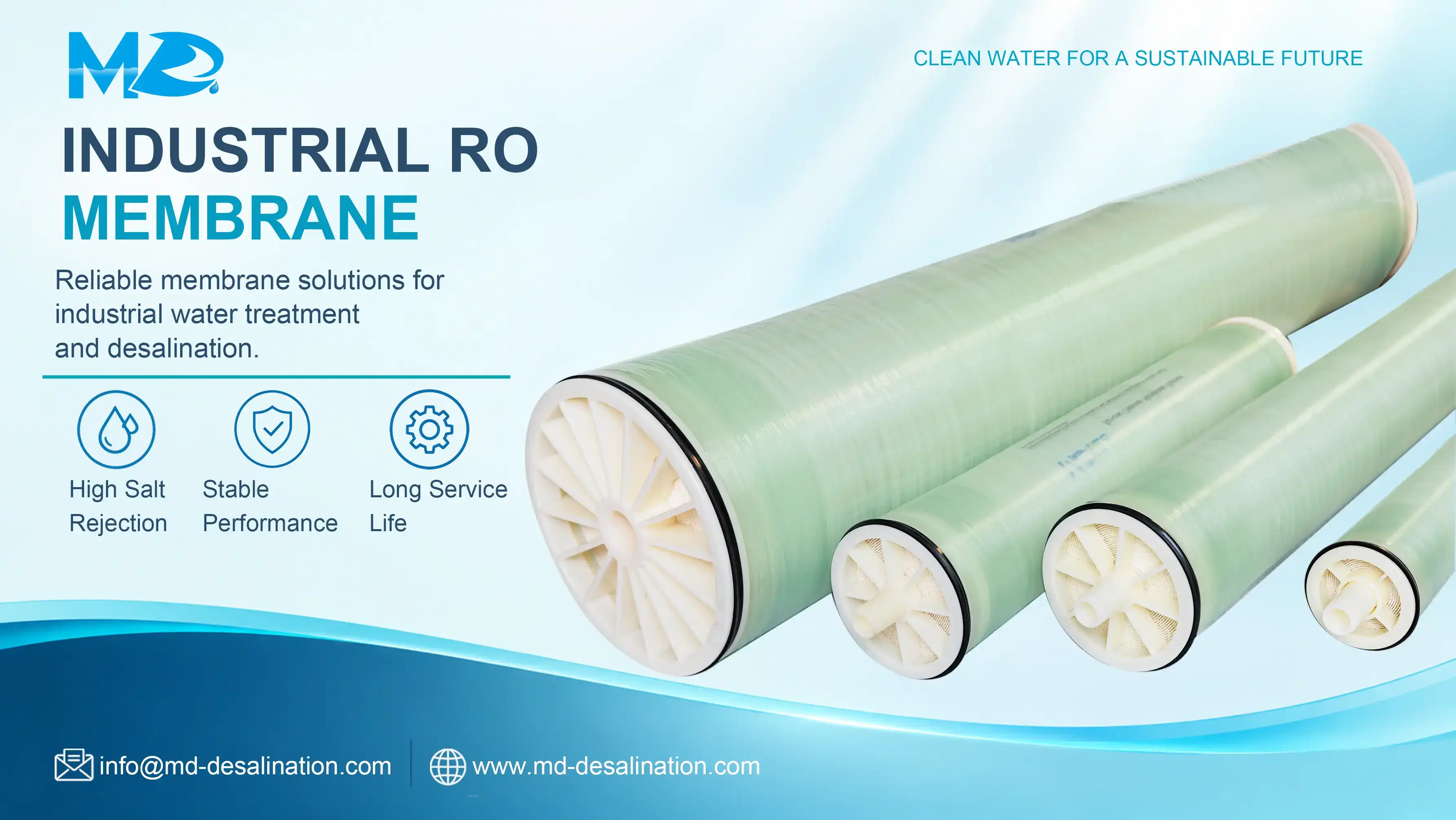
Xi’an Membrane Desalination International Co., LTD. manufactures and supplies RO membrane elements with OEM/ODM support. The following analysis draws on recent industry developments to help buyers contextualize membrane selection within the current technical landscape.
Trend One: Single-Pass Seawater Desalination Moves from Concept to Commercial Reality
The conventional architecture for seawater reverse osmosis (SWRO)—two-pass RO to meet boron and salinity limits—is being challenged by next-generation membrane chemistry. Toray’s TSW-K/M/V series, scheduled for commercial release in October 2026, reports salt permeability up to 55% lower than its existing TM820M and TSW-M models . The implication is direct: new SWRO projects can potentially eliminate the second RO pass, reducing both capital expenditure and specific energy consumption.
For brownfield facilities already operating two-pass systems, the value proposition is different but equally relevant. Replacing first-pass elements with higher-rejection membranes reduces the salinity load on the second pass, allowing operators to either lower second-pass operating pressure or improve permeate quality without additional energy input. The TSW series also claims improved boron rejection and chemical resistance, the latter being particularly important for facilities that rely on frequent alkaline or acidic cleaning cycles .
The broader technical direction is toward sub-nanometer pore structure control in the polyamide active layer. Toray’s development approach combines quantitative analysis of polyamide pore-size distribution with digital simulation of water-molecule interactions within membrane pores—engineering that targets neutral small molecules such as boron and urea, which resist removal by electrostatic exclusion alone .
Operator takeaway: If you are scoping a new SWRO facility, single-pass configurations merit a fresh feasibility review. For existing two-pass plants, first-pass membrane upgrade is a low-disruption pathway to capacity or quality gains.
Trend Two: PFAS Regulation Creates a New Membrane Specification Criterion
The U.S. regulatory landscape for PFAS in drinking water has been turbulent, but the core signal for membrane suppliers is unambiguous: PFOA and PFOS enforceable limits remain at 4.0 parts per trillion each. Under the current EPA framework, water systems may request a compliance deadline extension to April 2031, while the agency has proposed rescinding standards for four other PFAS compounds on procedural grounds . The PFOA/PFOS limits retain scientific and legal support.
For RO membranes, PFAS removal performance is increasingly evaluated alongside conventional salt rejection. A 2026 review consolidating over 130 studies confirms that RO membranes achieve high rejection of both long-chain and short-chain PFAS—typically in the 96–100% range—but notes that no single unit process is universally sufficient, particularly for short-chain compounds . Membrane fouling accelerates when treating PFAS-laden waters, and energy demand rises.
The practical implication is that RO membranes in PFAS treatment trains should not be specified in isolation. Effective configurations pair RO with upstream treatment—activated carbon or ion exchange—to reduce foulant load and extend membrane cleaning intervals. This integrated approach is becoming the default design philosophy for municipal systems facing PFAS compliance.
Operator takeaway: For drinking water applications, request PFAS rejection data (particularly for short-chain compounds) alongside standard salt rejection specifications. Plan for pretreatment integration rather than treating RO as a standalone barrier.
Trend Three: Fouling Control Shifts from Surface Modification to Active Self-Cleaning
Membrane fouling remains the dominant operational cost driver in RO systems. The research frontier has moved beyond passive surface chemistry—contact angle, zeta potential, hydrophilicity—toward membranes that actively degrade or repel foulants during operation.
A 2026 review in the Journal of Industrial and Engineering Chemistry examines reactive RO membranes incorporating photocatalytic or Fenton-active nanomaterials (TiO₂, g-C₃N₄, Fe-based catalysts) within the thin-film composite layer. These generate reactive oxygen species in situ to oxidize organic deposits, potentially reducing chemical cleaning frequency . A critical finding from techno-economic assessments: the economic viability of reactive membranes is overwhelmingly dictated by the magnitude of membrane lifespan extension. If self-cleaning capability does not meaningfully extend service life, the added material cost is difficult to justify .
The second approach is electroactive membranes. Research on laser-induced graphene (LIG) integrated into polysulfone support layers has demonstrated conductive thin-film composite membranes where applying a small electrical potential enhances antifouling performance and enables electrochemical cleaning . The technology remains at laboratory-to-pilot scale, but the direction is clear: shifting the membrane from passive resistance to active fouling mitigation.
Neither technology is yet positioned to displace conventional TFC membranes in mainstream commercial applications. The relevant signal for procurement is that fouling-resistance claims from suppliers should be scrutinized for mechanistic specificity. A contact angle value alone is insufficient; the question is whether the membrane architecture enables a measurable reduction in cleaning frequency or irreversible fouling rate under realistic feed conditions.
Operator takeaway: When evaluating “antifouling” membrane offerings, request pilot or field data on cleaning interval extension and flux recovery after cleaning cycles—not just surface characterization data.
What This Means for Membrane Selection
The three trends converge on a single procurement principle: RO membrane evaluation now requires application-specific performance data beyond standard specifications. Salt rejection and flow rate remain necessary, but they are no longer sufficient. For seawater applications, ask about boron rejection at system pH and single-pass feasibility. For drinking water, ask about PFAS rejection profiles and pretreatment compatibility. For high-fouling feeds, ask about mechanistic fouling control and field-validated cleaning intervals.
Xi’an Membrane Desalination International Co., LTD. supplies RO membrane elements for industrial, municipal, and specialized applications, with OEM and ODM capabilities and full testing support. For application-specific membrane selection or sample requests, contact:info@md-desalination.com.
References
1. U.S. Environmental Protection Agency. “Things You Need to Know: EPA Unveils Comprehensive PFAS Strategy.” May 21, 2026.
2. Federal Register. “Extending the Compliance Deadline for the PFOA and PFOS Maximum Contaminant Levels.” 91 FR 29425, May 2026.
3. Toray Industries. “Toray to Launch Next-Generation Reverse Osmosis Membranes Offering Industry-Leading Salt Rejection for More Cost-Effective Seawater Desalination.” IDRA, June 4, 2026.
4. Albalawi, G.H., et al. “Reactive nanomaterial-engineered reverse osmosis membranes: Mechanistic insights into photocatalytic and Fenton-based fouling mitigation for sustainable desalination.” Journal of Industrial and Engineering Chemistry, 2026. DOI: 10.1016/j.jiec.2026.08.007.
5. Drumond, G.P., et al. “Recent developments in membrane treatment technologies for PFAS removal from surface and groundwater.” Journal of Environmental Chemical Engineering, 2025.
6. “Membrane processes and materials for remediation of per- and polyfluoroalkyl substances from water and wastewater.” In Membrane-Based Technologies for PFAS Remediation, Elsevier, 2026.
7. Arnusch, C.J. “Laser-induced graphene fabricated on porous polyethersulfone membranes as electrically active antifouling and antimicrobial filters.” AIChE NAMS18 Conference Presentation, 2018.
8. CompositesWorld. “Toray to launch TSW-K/M/V series reverse osmosis membranes.” June 11, 2026.