What does an ro membrane do?
What Does an RO Membrane Do?
In water purification, the RO membrane (Reverse Osmosis membrane) plays a critical role. This technology is widely used in both residential and industrial settings to ensure clean, safe drinking water. By understanding the functions and benefits of RO membranes, you can make informed decisions about your water purification needs.
At Xi'an Membrane Desalination International Co., Ltd., we specialize in manufacturing high-quality RO membranes. Whether you need custom solutions or ready-to-use products, we offer OEM and ODM services to meet your specific requirements. If you are in the market for an RO membrane, contact us at info@md-desalination.com to request free samples and explore how our products can benefit you.
What Is an RO Membrane?
An RO membrane serves as a semi-permeable membrane critical to the reverse osmosis process, effectively purifying water by selectively filtering impurities. This technology effectively removes a wide array of contaminants, including salts, minerals, and organic compounds, thereby producing clean, purified water. Its significance spans diverse applications, from essential household drinking water systems to demanding industrial processes where water quality is paramount.
In residential settings, RO membranes play a pivotal role in providing safe, great-tasting water by eliminating dissolved solids and potential contaminants that affect taste and odor. They are integral components of home water filtration systems, contributing to better health and well-being by ensuring water purity.
In industrial applications, RO membranes are indispensable for processes requiring high-purity water, such as pharmaceutical manufacturing, electronics production, and power generation. By efficiently removing contaminants, these membranes help maintain product quality, extend equipment lifespan, and improve operational efficiency.
The versatility of RO membranes lies in their ability to deliver consistently high-quality water through a reliable filtration mechanism. This reliability makes them a preferred choice across various sectors where consistent water purification is essential for operational success and public health.
How Does Reverse Osmosis Work?
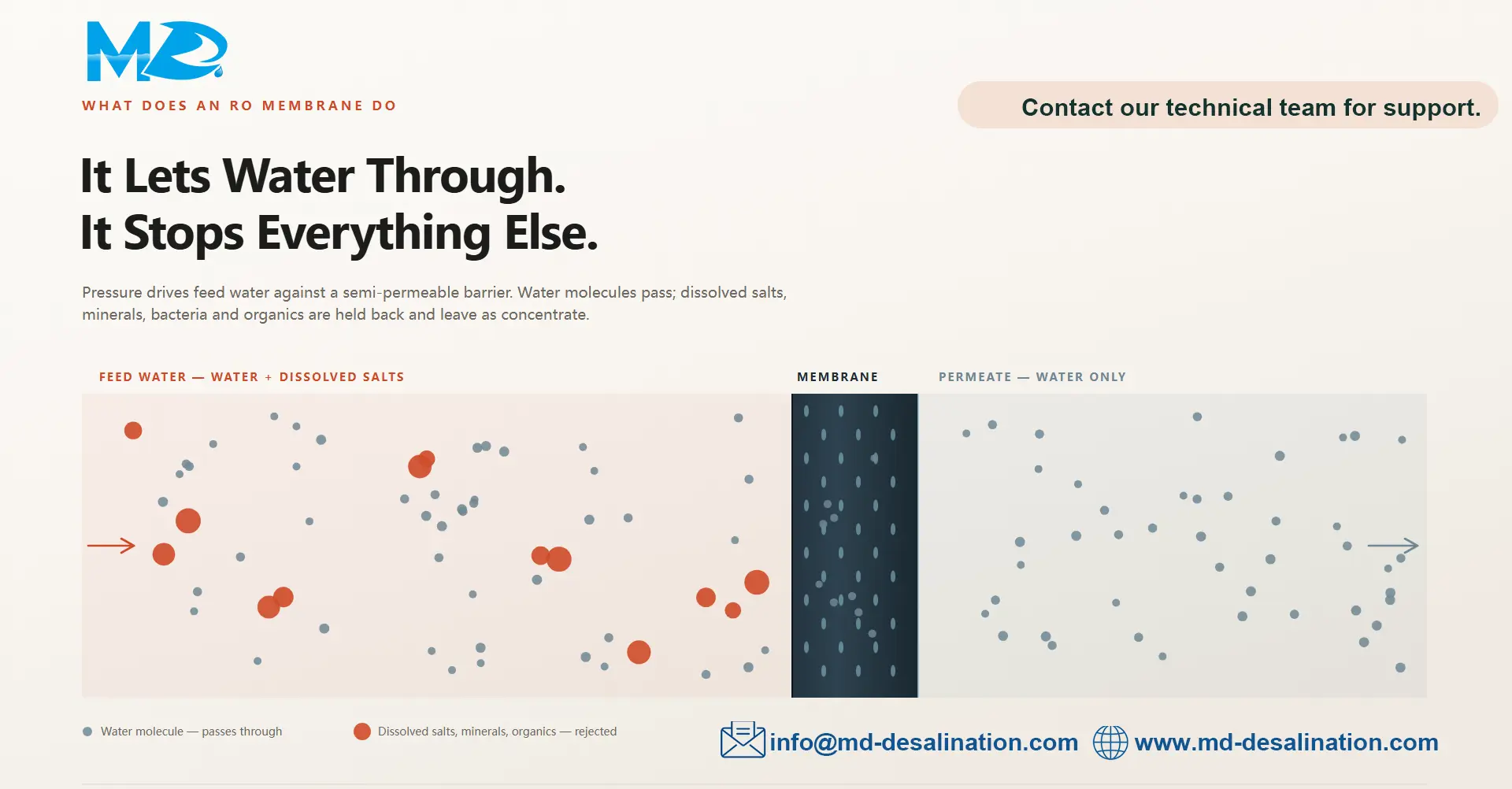
Reverse osmosis (RO) is a sophisticated water purification process that applies pressure to drive water molecules through a semi-permeable membrane. This membrane selectively allows water molecules to pass through, effectively separating them from contaminants and impurities that cannot penetrate its microscopic pores. As a result, purified water emerges on one side of the membrane, while a concentrated waste stream—known as concentrate, reject water, or brine—is generated on the other.
The principle behind RO involves applying hydraulic pressure to overcome natural osmotic forces, ensuring that only pure water molecules permeate through the membrane. This systematic filtration process efficiently removes a diverse range of pollutants, including dissolved salts, minerals, heavy metals, and organic compounds, which may compromise water quality and safety.
RO technology is widely used across various sectors, from domestic applications providing clean drinking water to large-scale industrial processes requiring ultrapure water for manufacturing and production. Its ability to deliver consistently high-quality water makes it indispensable in enhancing public health, supporting sustainable development goals, and optimizing operational efficiency in industrial settings.
By understanding how reverse osmosis works, stakeholders can implement tailored water treatment solutions that meet strict quality standards and environmental regulations, ensuring reliable access to safe, purified water.
What Are the Benefits of Using an RO Membrane?
The main advantage of using an RO membrane lies in its capability to produce superior quality, purified water. By effectively filtering a wide spectrum of impurities, including salts, minerals, and organic compounds, RO membranes significantly enhance both the taste and safety of water. This purification process ensures that contaminants detrimental to health and aesthetics are efficiently removed, resulting in water that is not only clean but also pleasant to drink.
Moreover, the implementation of RO membranes can help prolong the lifespan and improve the efficiency of appliances that use water. By reducing the accumulation of scale deposits and corrosion-causing substances within pipes, water heaters, and other water-dependent equipment, they help maintain optimal performance and operational longevity. This benefit is particularly valuable in households and industries where equipment maintenance and efficiency are crucial for cost control and productivity.
In summary, RO membranes stand out for their dual benefits of delivering high-quality drinking water and protecting water-using appliances. Their role in enhancing water purity and extending equipment durability underscores their importance in both residential and industrial settings, where reliable water quality and operational efficiency are key priorities.
How Do I Choose the Right RO Membrane for My Needs?
Selecting the right RO membrane depends on several factors, including the quality of your source water and the specific requirements of your application. Considerations include membrane size, flow rate, and rejection rate. Our experts at Xi'an Membrane Desalination International Co., Ltd. can assist you in finding the right membrane for your needs.
Conclusion
Understanding what an RO membrane does and how it works can significantly impact your choice of water purification systems. This technology offers an effective solution for producing clean and safe drinking water by removing contaminants. Whether for home use or industrial applications, the right RO membrane ensures optimal performance and water quality.
If you are considering upgrading or purchasing a new RO membrane, Xi'an Membrane Desalination International Co., Ltd. is here to help. As a professional manufacturer and supplier, we offer a wide range of RO membranes with large stock, full certifications, and fast delivery. For more information or to request free samples, please contact us at info@md-desalination.com. We look forward to helping you find the right solution for your water purification needs.
References
1. Water Quality Association. "Reverse Osmosis: How It Works." Accessed October 20, 2026. https://www.wqa.org.
2. U.S. Environmental Protection Agency. "Understanding RO Membranes." Accessed October 20, 2026. https://www.epa.gov.
3. International Desalination Association. "RO Membrane Technology." Accessed October 20, 2026. https://idadesal.org.