What material is used for RO?
What Material Is Used for RO?
Reverse Osmosis (RO) is a widely utilized technology for water purification, used in both industrial and residential settings. At its core, RO involves the passage of water through a semi-permeable membrane to remove impurities and contaminants. However, the effectiveness of this process largely depends on the materials used in constructing the membrane.
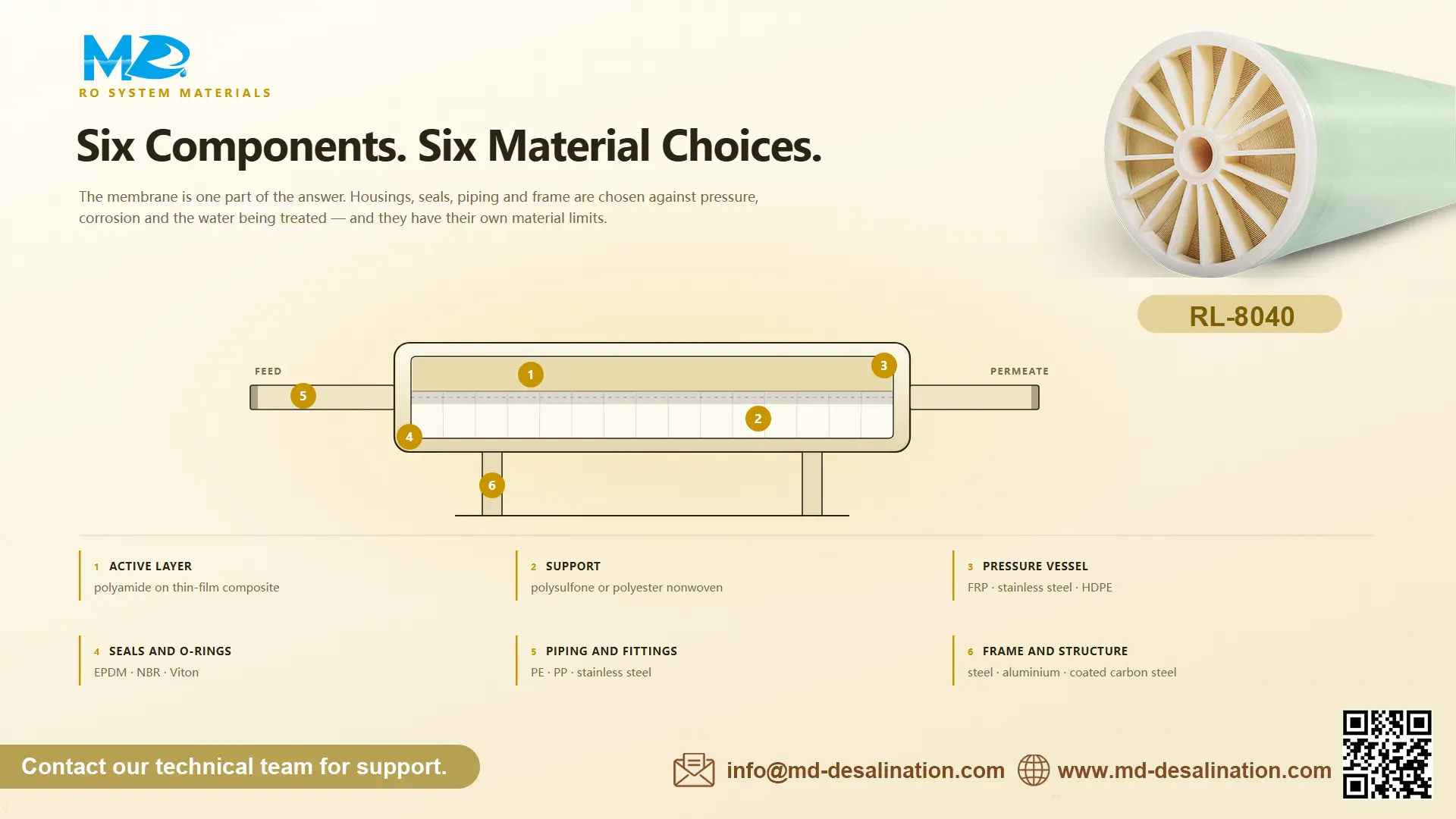
In Reverse Osmosis (RO) systems, different materials are utilized for distinct components to ensure the system's effectiveness, durability, and compatibility with water treatment processes. Here are some common materials used in RO systems:
· Membrane Material: RO membranes, the primary components responsible for separating purified water from contaminants, are typically made from engineered polymer materials. Thin-film composite (TFC) membranes are the most commonly used type in modern RO systems. TFC membranes consist of multiple layers, including a thin polyamide barrier layer supported by a porous substrate. This construction provides high rejection rates and durability.
· Membrane Support: The backing material for RO membranes is usually made from a porous polymer or nonwoven fabric, such as polysulfone or polyester, which provides mechanical support and enhances water flow through the membrane.
· Housings: The housings or pressure vessels that contain the RO membranes are commonly made from strong materials such as fiberglass-reinforced plastic (FRP), stainless steel, or high-density polyethylene (HDPE). These materials offer corrosion resistance, strength, and long-term durability under high-pressure conditions.
· Seals and O-Rings: Seals and O-rings used in RO systems are typically made from materials such as ethylene propylene diene monomer (EPDM), nitrile rubber (NBR), or Viton®. These elastomeric materials provide a reliable seal to prevent leakage and ensure the integrity of the system.
· Piping and Fittings: Piping and fittings in RO systems are commonly made from materials such as polyethylene (PE), polypropylene (PP), or stainless steel. These materials offer chemical resistance, strength, and compatibility with water treatment processes.
· Frame and Structural Components: Structural components and frames in RO systems may be made from materials such as stainless steel, aluminum, or coated carbon steel. These materials provide stability, strength, and corrosion resistance to support the components and withstand the operating conditions of the system.
Overall, the selection of materials for RO systems depends on factors such as the specific application, water quality, operating conditions, and regulatory requirements. It is essential to select materials that are compatible with the water being treated and that meet the performance and durability requirements of the system.
Understanding Reverse Osmosis
Before delving into the materials used for RO membranes, it is essential to grasp the fundamental principles of reverse osmosis. In RO, pressure is applied to a concentrated solution, forcing water through a semi-permeable membrane, leaving behind dissolved solids, contaminants, and impurities. The membrane's selective permeability allows water molecules to pass through while blocking larger molecules and ions, resulting in purified water on one side and concentrated wastewater on the other.
Polyamide Thin-Film Composite (TFC) Membranes
One of the most commonly used materials for reverse osmosis membranes is polyamide thin-film composite (TFC). TFC membranes consist of multiple layers, with the active layer typically composed of polyamide, a synthetic polymer known for its excellent chemical and thermal stability. The porous support layer provides structural integrity, while the thin polyamide layer facilitates selective permeation of water molecules, effectively filtering out contaminants.
Cellulose Acetate Membranes
Another material utilized in RO membranes is cellulose acetate. Cellulose acetate membranes are derived from natural cellulose fibers, chemically modified to enhance their water purification properties. While cellulose acetate membranes offer good permeability to water, they are more prone to fouling and degradation compared to polyamide membranes, limiting their applications in certain environments.
Polyethersulfone (PES) Membranes
Polyethersulfone (PES) membranes have gained popularity in recent years due to their superior chemical resistance and mechanical strength. These membranes are highly effective in removing a wide range of contaminants, including bacteria, viruses, and heavy metals. PES membranes are particularly well-suited for applications requiring high durability and resistance to fouling, making them ideal for industrial water treatment systems.
Hydrophilic vs. Hydrophobic Membranes
Reverse osmosis membranes can be classified based on their affinity for water molecules, with hydrophilic membranes attracting water and hydrophobic membranes repelling water.
· Hydrophilic Membranes: Hydrophilic membranes have a surface that attracts water molecules and allows water to pass through easily. These membranes are wettable, meaning they readily absorb water and have a high affinity for water molecules. They are commonly used in applications where water permeability and high flux rates are desirable, such as ultrafiltration and microfiltration. Examples include cellulose acetate, polyvinylidene fluoride (PVDF), polyethersulfone (PES), and regenerated cellulose.
· Hydrophobic Membranes: Hydrophobic membranes have a surface that repels water molecules and prevents water from passing through easily. These membranes are non-wettable, meaning they do not readily absorb water and have low affinity for water molecules. They are commonly used in applications where selective separation of non-polar substances or gases from water is required, such as gas separation, vapor permeation, and oil-water separation. Examples include polytetrafluoroethylene (PTFE), polypropylene (PP), polyethylene (PE), and certain types of silicone-based membranes.
In summary, hydrophilic membranes are characterized by their ability to attract and pass water molecules easily, making them suitable for applications requiring high water permeability. In contrast, hydrophobic membranes repel water molecules and are used for applications requiring selective separation of non-polar substances or gases from water. The choice between hydrophilic and hydrophobic membranes depends on the specific requirements of the application, including desired separation properties, chemical compatibility, and operating conditions.
Conclusion
In conclusion, the materials used for Reverse Osmosis membranes play a crucial role in determining the efficiency and effectiveness of the water purification process. Polyamide thin-film composite (TFC) membranes are widely used due to their excellent permeability and selectivity. However, other materials such as cellulose acetate and polyethersulfone (PES) offer unique advantages in terms of durability, chemical resistance, and mechanical strength. By understanding the properties of different membrane materials, engineers and researchers can develop innovative solutions to address the growing demand for clean and safe drinking water.
Need professional advice on water treatment solutions?
Whether you are selecting the right membrane for your specific application or optimizing your RO system, our technical team is here to help. Contact us at info@md-desalination.com for expert guidance and product inquiries.
References
1. WaterWorld. "The Evolution of Reverse Osmosis Membranes." https://www.waterworld.com/home/article/16201881/the-evolution-of-reverse-osmosis-membranes
2. ScienceDirect. (2015). Membrane Materials for Water Treatment. https://www.sciencedirect.com/science/article/pii/S0149639515003045
3. Lenntech. "Reverse Osmosis Materials." https://www.lenntech.com/library/reverse-osmosis/ro/reverse-osmosis-materials.htm