Why Boron Is the New Specification Battleground
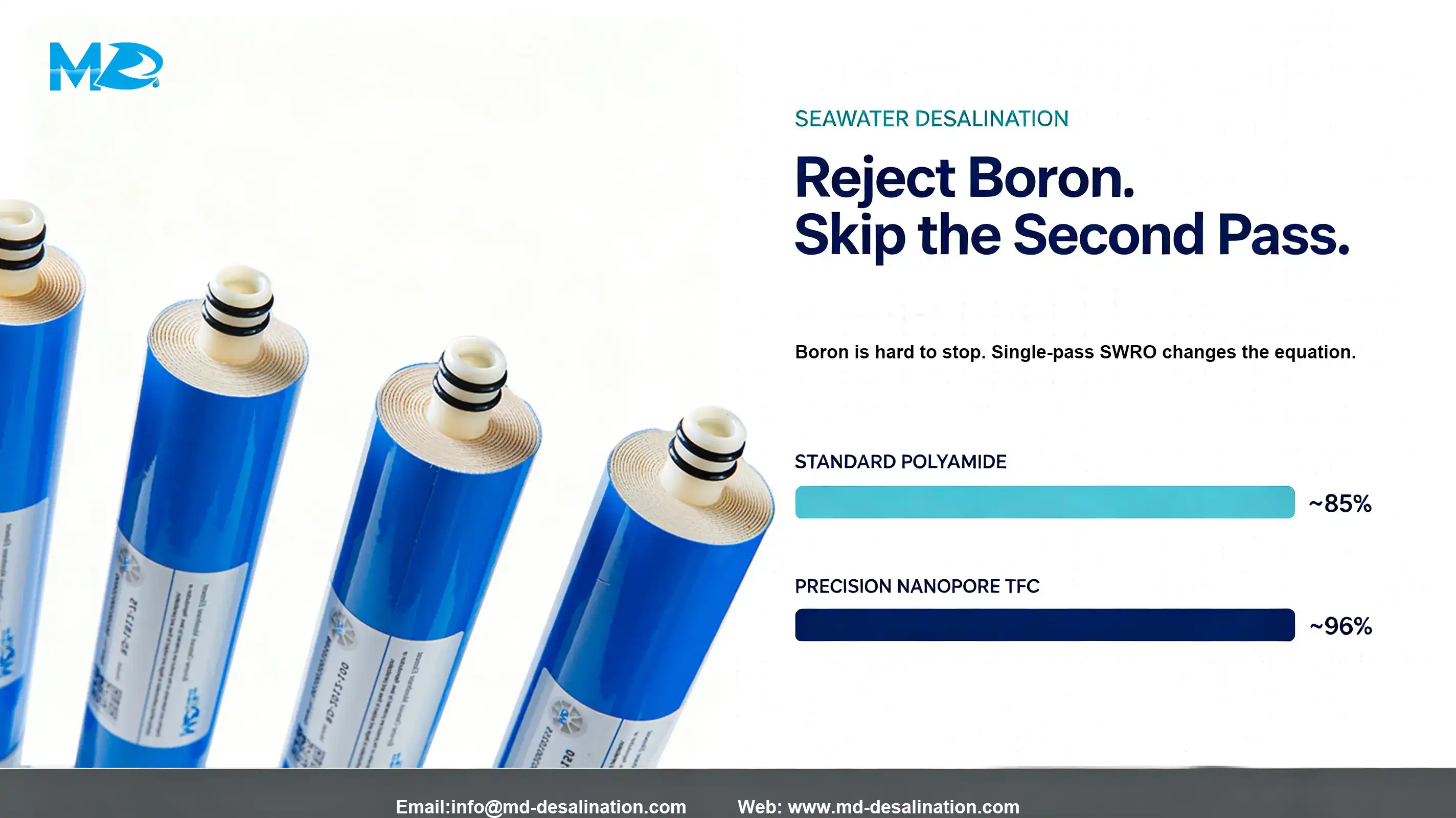
For most of the RO membrane industry’s history, boron rejection was a niche concern. Seawater desalination plants in regions with lenient water quality standards could treat boron as a secondary parameter. That assumption is no longer viable. Tightening drinking water regulations and the shift toward single-pass seawater RO are pushing boron rejection from a secondary data point to a primary specification criterion.
The technical difficulty is structural. Boric acid is a small, neutral molecule at typical seawater pH, and its transport through polyamide membranes is mechanistically similar to that of water itself. Charge-based rejection—the mechanism that works well for salts—offers limited leverage against boron. This is why conventional polyamide membranes struggle to meet boron limits without operating at elevated pH, which introduces scaling risk and energy penalties.
The Single-Pass Boron Problem
Toray’s TSW-K/M/V series, scheduled for October 2026 commercial launch, targets this exact constraint. The company claims salt permeability up to 55% lower than existing TM820M/TSW-M models, with boron rejection performance positioned to meet stringent drinking water and industrial quality requirements . The stated objective is enabling new seawater desalination projects to shift from two-pass to single-pass RO configuration.
For single-pass seawater RO to work, boron rejection cannot be an afterthought. The membrane must reject enough boron at system pH to meet regulatory limits without requiring a second pass or alkaline pretreatment. Toray’s approach involves precision nanopore control, combining quantitative analysis of polyamide pore size distribution with digital simulation of water-molecule interactions within membrane pores . The mechanism is size-based exclusion at the sub-nanometer scale, not charge repulsion.
Why Boron Is Mechanistically Harder Than Salt
The difficulty with boron is not a matter of membrane quality. It is a matter of molecular similarity. Boric acid (B(OH)₃) is uncharged at neutral pH, small enough to pass through the free-volume elements of the polyamide active layer, and capable of forming hydrogen bonds in a manner that mimics water transport. Salt ions (Na⁺, Cl⁻) are rejected primarily through Donnan exclusion and dielectric effects; boron does not respond to those mechanisms in the same way.
Recent research on thin-film nanocomposite (TFN) membranes has focused on layered double hydroxides (LDHs) as a potential pathway for boron-selective rejection. Unlike more porous nanomaterials, LDHs offer a dense, hydroxyl-rich interface with tunable interlayer chemistry, positioning them as a platform for selective solute capture . The mechanism is affinity-based interaction with boric acid, combined with interlayer spacing control. The research is still early-stage, but the direction is clear: boron rejection requires a different design logic than salt rejection.
What This Means for Specification
The practical implication for seawater desalination procurement is that boron rejection data is becoming as important as salt rejection data. A membrane that achieves 99.7% salt rejection but delivers insufficient boron rejection at system pH will require a second pass, neutralizing the capital and energy savings that single-pass configurations promise.
The questions worth asking suppliers now are specific: what is the boron rejection performance at the operating pH of the system, not at elevated pH where boron speciation shifts toward the more easily rejected borate ion? How does that performance hold up across the membrane’s expected service life, as fouling and chemical cleaning alter surface characteristics? And is there field data from comparable single-pass installations, not just pilot-scale test results?
Xi’an Membrane Desalination International Co., LTD. supplies industrial-grade and seawater desalination RO membrane elements, with OEM and ODM support and full testing capabilities. For membrane selection discussions specific to boron rejection requirements or single-pass seawater configurations, contact us:
info@md-desalination.com
www.md-desalination.com
References
-
Advances in Thin-Film Nanocomposite (TFN) Reverse Osmosis Membranes for Desalination and Boron Removal. ACS Publications, 2026.
-
Toray Industries. “Toray to Launch TSW-K/M/V Series Reverse Osmosis Membranes.” CompositesWorld, June 2026.
-
Toray Industries. “TSW-K/M/V Series Seawater Desalination RO Membrane Elements.” Product Announcement, 2026.