Why does lsi increase with recovery in RO membrane?
Introduction
Reverse osmosis (RO) membranes are critical to water purification, but their performance can be compromised by various factors. One such factor is the Langelier Saturation Index (LSI), which quantifies the calcium carbonate scaling potential of water. This article examines why LSI increases with higher recovery rates in RO systems and discusses the operational implications.
Xi'an Membrane Desalination International Co., LTD. is a professional RO membrane manufacturer and supplier offering OEM and ODM services. For RO membrane selection or technical consultation, contact us at info@md-desalination.com. Free samples are available.
What Is LSI and Why Is It Important in RO?
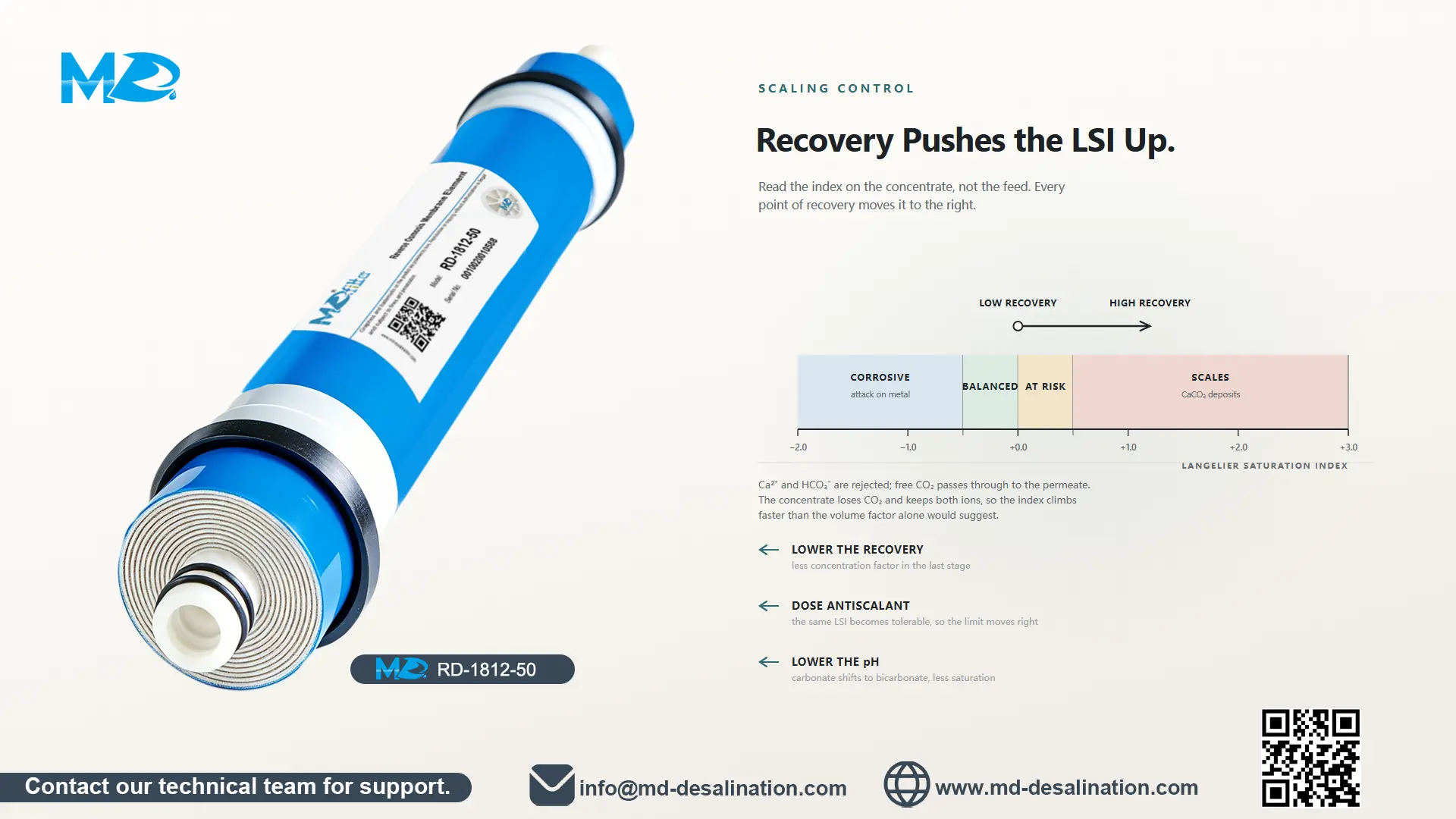
The Langelier Saturation Index (LSI) is a calculated parameter used to predict whether calcium carbonate (CaCO₃) will precipitate or remain dissolved. In RO system design and operation, LSI is not applied to the feed water alone—it must be calculated for the concentrate stream, because the concentration of dissolved solids and the differential passage of calcium ions, bicarbonate ions, and free CO₂ across the membrane make the concentrate’s scaling behavior significantly different from that of the feed.
A positive LSI indicates that the concentrate stream is supersaturated with respect to CaCO₃, creating a thermodynamic driving force for scale deposition on membrane surfaces. A negative LSI indicates undersaturation; if excessively negative, the water may be corrosive to metallic components.
For RO operators, LSI serves as a decision-making tool: it determines whether scale control measures—such as pH adjustment, antiscalant dosing, or recovery rate limitation—are required to prevent CaCO₃ precipitation within the membrane element.
How Does Recovery Rate Affect LSI in RO Systems?
Recovery rate is defined as the percentage of feed water that passes through the membrane as permeate. As recovery increases, the remaining concentrate stream contains a higher concentration of dissolved salts and minerals. However, the relationship is not merely one of concentration—the rejection characteristics of the membrane cause differential accumulation of species: calcium and bicarbonate ions are rejected while free CO₂ passes through the membrane, shifting the carbonate equilibrium in the concentrate toward scale formation.
Consequently, higher recovery rates generally produce higher LSI values in the concentrate stream. Once LSI exceeds zero, the concentrate becomes supersaturated with CaCO₃, and the risk of scale formation on the membrane surface increases. This is why recovery rate is a primary operational lever for scaling control: it directly determines the concentration factor applied to the feed water and therefore the extent to which LSI rises in the final stage of the array.
What Are the Risks Associated with Elevated LSI?
Elevated LSI in the concentrate stream leads directly to calcium carbonate scaling—the deposition of CaCO₃ crystals on the membrane surface. Scale formation reduces membrane permeability, increases feed pressure requirements, and can cause physical damage to the membrane element if left uncontrolled.
The operational consequences include:
· Increased cleaning frequency: Scale must be removed with appropriate chemical cleaning agents; repeated cleaning cycles eventually degrade membrane performance.
· Membrane fouling escalation: Scale deposits provide nucleation sites for other foulants (organics, colloids, biological matter), accelerating the fouling process.
· Irreversible damage: Severe or prolonged scaling can permanently impair membrane rejection and flow characteristics, necessitating element replacement.
How Can LSI Be Managed in RO Systems?
Effective LSI management in RO operations relies on three primary strategies:
1. Recovery rate optimization: Limiting recovery reduces the concentration factor and keeps concentrate LSI within acceptable bounds. This is the most direct control parameter.
2. Antiscalant dosing: Antiscalants (e.g., phosphonates, polyacrylic acid-based formulations) inhibit crystal nucleation and growth, allowing operation at higher LSI values without scale formation. Dosage must be optimized based on feed water analysis and system recovery.
3. Feed water pretreatment and pH adjustment: Softening or dealkalization removes scale-forming ions before they reach the membrane. pH adjustment shifts the carbonate equilibrium; lowering pH converts carbonate to bicarbonate and reduces CaCO₃ saturation, though this must be balanced against membrane pH tolerance and CO₂ passage.
Continuous monitoring of concentrate LSI—calculated from feed water analysis and operating parameters—is essential for proactive adjustment. ASTM D3739 provides the standard methodology for LSI calculation in RO applications.
Conclusion
Understanding the relationship between recovery rate and concentrate-stream LSI is fundamental to RO scaling control. By managing recovery, applying appropriate antiscalant chemistry, and monitoring LSI against established limits, operators can maintain membrane performance and extend element service life.
Contact Us
Xi'an Membrane Desalination International Co., LTD. is a professional RO membrane manufacturer and supplier, with large inventory, complete certifications, fast delivery, and strict packaging. We support testing, OEM, and ODM services. For RO membrane selection, contact us at info@md-desalination.comhttp://info@md-desalination.com.
References
1.ASTM D3739-19, Standard Practice for Calculation and Adjustment of the Langelier Saturation Index for Reverse Osmosis, ASTM International, West Conshohocken, PA, 2019.
2.Hydranautics. "RO Water Chemistry." Technical Paper.
3.ELGA LabWater. "The Effect of Increasing Reverse Osmosis (RO) Recovery." Technical Note TN35.