Why RO Membranes Fail Early: The Hidden Costs of Inadequate Pretreatment
In the reverse osmosis industry, a pervasive misconception persists: that membrane failure is primarily a product defect. When an element loses salt rejection or experiences a sudden drop in flux, the immediate assumption is often that the manufacturer supplied a faulty product. However, field data and membrane autopsies consistently reveal a different reality. The vast majority of premature RO membrane failures are not caused by manufacturing defects, but by upstream pretreatment failures. The factors that determine whether a membrane element lasts two years or five years are largely decided before the feed water even reaches the pressure vessel.
Membrane elements account for 35–45% of total RO system operating expenditure. Replacing an 8-inch element prematurely is not just a matter of a USD 300 part; it involves labor costs, system downtime, and the cascading operational inefficiencies of a compromised system. Understanding how pretreatment dictates membrane lifespan is the first step toward optimizing total cost of ownership.
1. The Chlorine Threat and Oxidation
Polyamide thin-film composite (TFC) membranes are the industry standard due to their high flux and excellent salt rejection. However, their Achilles' heel is their vulnerability to oxidizing agents, particularly free chlorine. Chlorine attacks the polyamide active layer, breaking chemical bonds and causing structural degradation that manifests as increased salt passage and, eventually, complete loss of rejection.
Polyamide membranes tolerate approximately 1,000 ppm·h of free chlorine exposure before irreversible damage occurs. In practical terms, this means free chlorine must be reduced to below 0.1 ppm in the feed water.
While activated carbon filtration is common, sodium bisulfite (SBS) injection is the preferred method for larger industrial systems because it is easier to control and monitor. The critical component here is not just the dosing pump, but the monitoring. An Oxidation-Reduction Potential (ORP) sensor interlocked to the high-pressure pump is essential. If the ORP reading indicates a chlorine breakthrough, the system must shut down automatically to prevent the feed water from destroying the membrane array. Relying on manual testing or unmonitored dosing is a gamble that often ends in expensive element replacement.
2. Silt Density Index (SDI) and Particulate Fouling
Suspended solids—such as clay, silt, colloidal silica, and iron flocs—accumulate on the membrane surface, blocking the feed channels and increasing the differential pressure across the vessel. The Silt Density Index (SDI) is the universal metric for measuring this fouling potential.
Most membrane manufacturers mandate a feed water SDI of less than 5, with an SDI of 3 or lower highly recommended for systems operating at high recovery rates. When SDI exceeds these limits, the membrane essentially becomes a filter for particles it was never designed to capture.
A common operational pitfall is relying on periodic grab samples to measure SDI. SDI can spike intermittently—especially after backwashing multimedia filters or during seasonal changes in source water turbidity. Continuous SDI monitoring, or at least monitoring turbidity as a proxy, allows operators to adjust pretreatment parameters (such as coagulant dosing or filter backwash frequency) before the membrane is compromised.
3. The Chemistry of Scaling
Mineral scaling occurs when dissolved salts—calcium carbonate, calcium sulfate, barium sulfate, and silica—exceed their solubility limits in the concentrate stream. As recovery rates increase, the concentration of these ions in the brine rises, pushing them toward precipitation.
For calcium carbonate, the Langelier Saturation Index (LSI) is the standard control parameter. Antiscalant dosing allows operators to push the LSI beyond the theoretical saturation point without scaling. However, the dosage must be precisely matched to the feed water chemistry, recovery rate, and temperature. Underdosing during seasonal hardness spikes is a frequent cause of scaling events.
Once scale forms, it is notoriously difficult to remove. Acid cleaning may dissolve carbonate scale, but sulfate and silica scales often require aggressive, specialized chemicals that can shorten the membrane's lifespan. Therefore, scaling control must be proactive, relying on accurate water analysis and automated antiscalant dosing systems.
The Procurement Implication: Asking the Right Questions
When selecting an RO membrane, evaluating the datasheet alone is insufficient. The membrane must be matched to the specific pretreatment design and feed water conditions of the project.
When engaging with suppliers, plant operators and engineering firms should ask:
-
What feed water SDI and chlorine limits are recommended for this specific element?
-
What cleaning interval data exists for installations with similar feed water chemistry?
-
Does the supplier offer field support or membrane autopsy services to diagnose premature fouling?
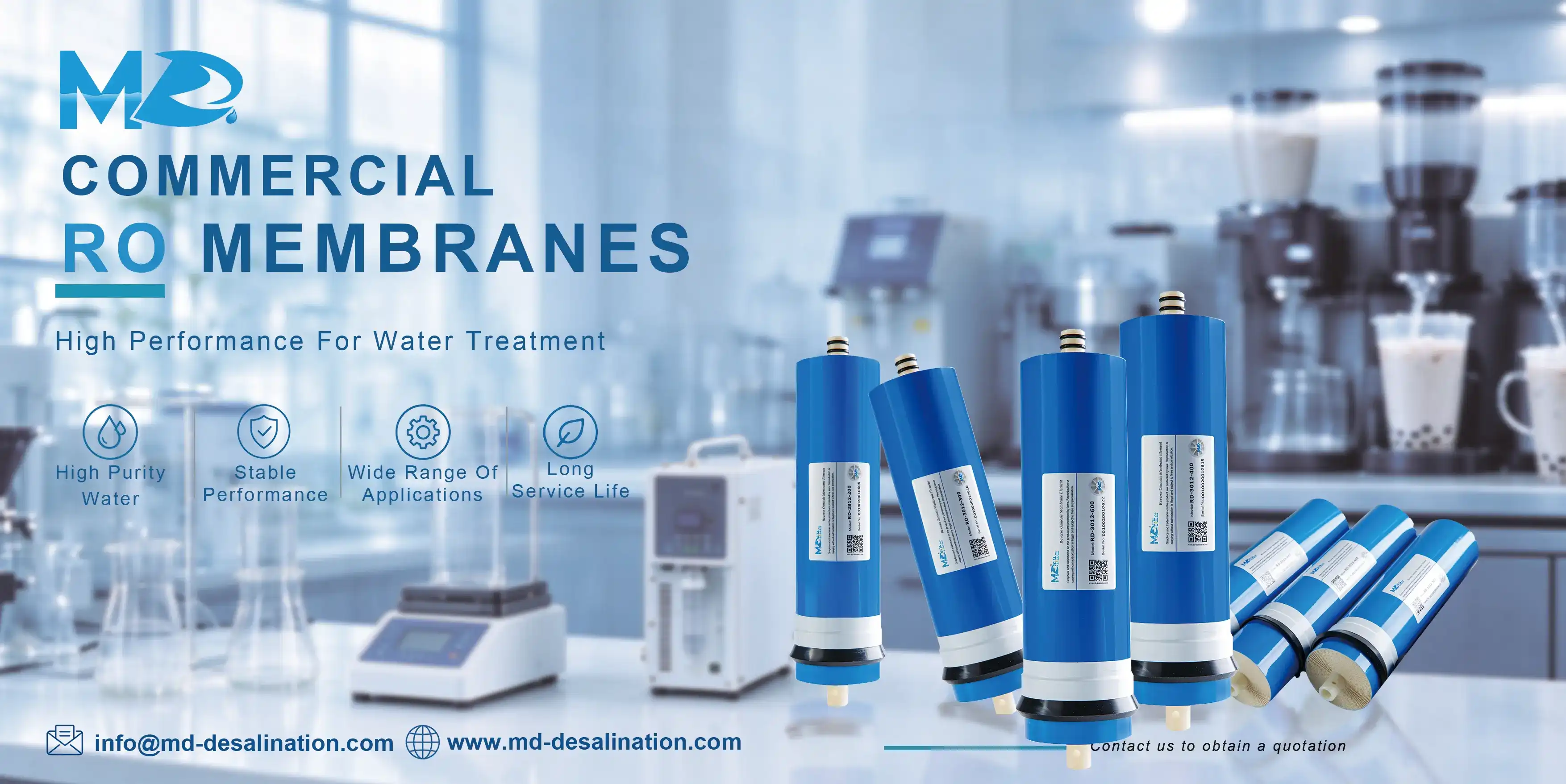
Xi’an Membrane Desalination International Co., LTD. supplies industrial-grade and seawater desalination RO membrane elements, with OEM and ODM support and comprehensive testing capabilities. We believe that a membrane is only as good as the system protecting it. For membrane selection discussions specific to your pretreatment design and feed water chemistry, contact us:
info@md-desalination.com
www.md-desalination.com
References
-
Gohil, J.M. and Suresh, A.K. "Chlorine attack on reverse osmosis membranes: Mechanisms and mitigation strategies." Journal of Membrane Science, vol. 541, 2017.
-
American Water Works Association. "RO Membrane Operation and Maintenance." AWWA, 2023.
-
U.S. Bureau of Reclamation. "Membrane Autopsy and Performance Evaluation." Technical Report, 2024.