Beyond Standard Desalination: How RO Membrane Technology Is Solving the Hardest Water Challenges of 2026
Introduction
The reverse osmosis membrane market is no longer just about producing drinking water from seawater. In 2026, the industry is valued at approximately $5.66 billion and is projected to reach $8.38 billion by 2031, driven by far more demanding applications. Industrial zero-liquid-discharge (ZLD) mandates, water reuse for potable purposes, and the need to treat hypersaline brines are pushing conventional RO membranes to their limits. For plant operators and system designers, the question is no longer whether RO works—it is whether their chosen membrane can handle the specific, often extreme, chemistry of their feed water.
This article examines the technological shifts reshaping RO membrane performance in 2026, from ultraselective barrier layers to boron rejection breakthroughs, and what these developments mean for industrial water treatment strategies.
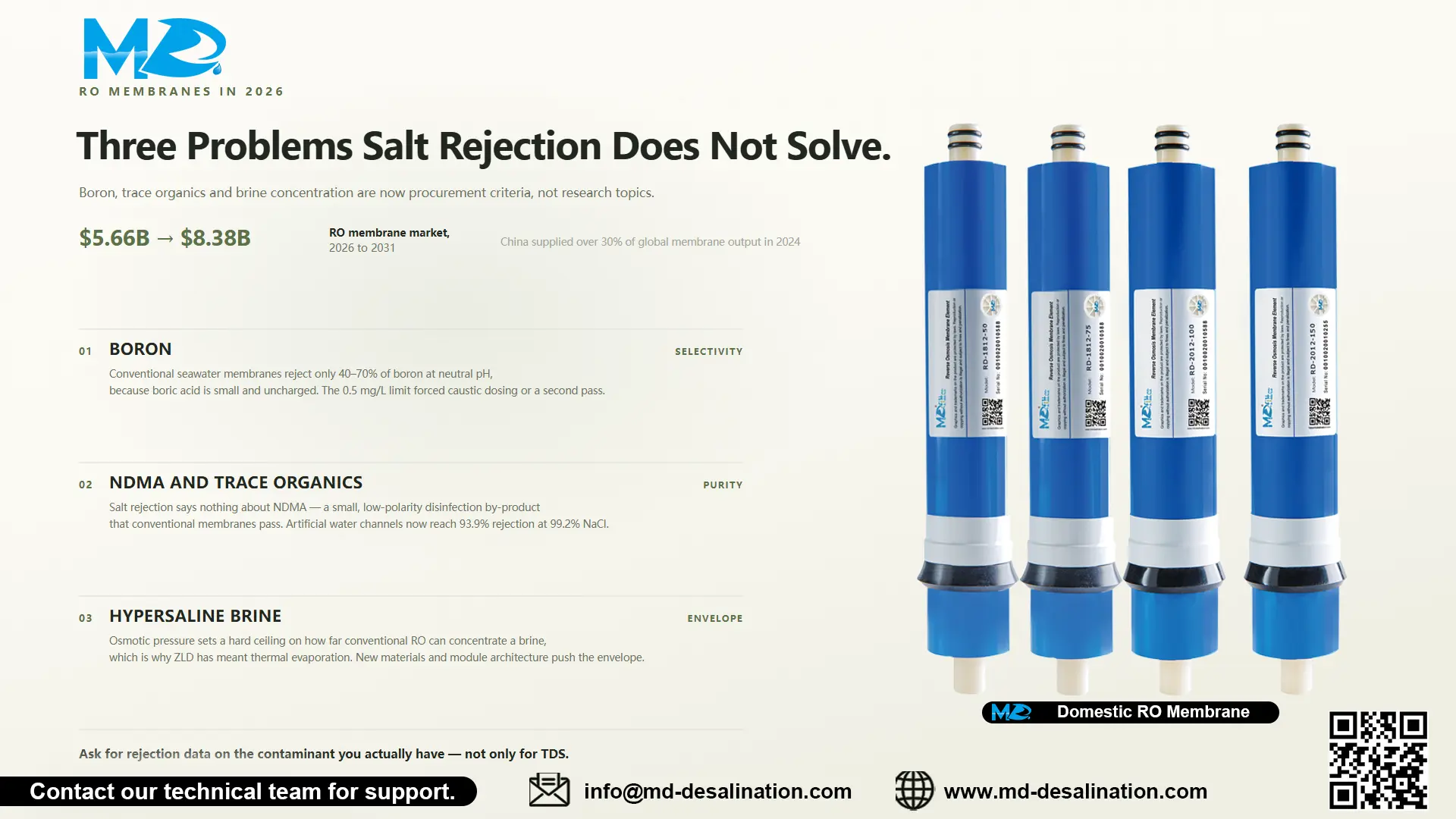
The Boron Bottleneck: Why Conventional Membranes Fall Short
Boron has long been one of the most persistent challenges in seawater desalination. At typical seawater pH levels around 8, boron exists primarily as boric acid—a small, neutral molecule that passes through polyamide active layers with minimal resistance. Commercial seawater RO membranes typically achieve only 40% to 70% boron rejection at neutral pH. To meet the stringent 0.5 mg/L permeate limit for drinking water and industrial applications, operators have historically relied on energy-intensive workarounds: elevating pH with caustic dosing, or running a second RO pass.
In 2026, membrane manufacturers are attacking this problem at the molecular level. Recent research highlights thin-film nanocomposite (TFN) membranes incorporating layered double hydroxides (LDHs) as chemically active fillers, designed to impart boron selectivity even at neutral pH. Separately, a cryptand-enhanced polyamide membrane developed by researchers uses a three-dimensional cage-like molecular structure to recognize and reject boron while simultaneously improving water flux and salt rejection. A 0.5 m × 1.1 m flat-sheet prototype of this membrane demonstrated stable performance over 500 hours of real seawater testing.
The commercial implication is significant. Toray’s newly developed seawater RO membrane, scheduled for October 2026 launch, claims salt permeability up to 55% lower than current models, enabling new desalination projects to switch from two-pass to single-pass treatment. For existing two-pass facilities, this translates directly into energy savings and reduced operational loads.
Ultraselective Membranes for Water Reuse: Beyond Salt Rejection
As municipalities increasingly pursue potable water reuse, RO membranes face a new class of contaminants that conventional salt rejection metrics do not capture. N-nitrosodimethylamine (NDMA) is a disinfection byproduct and probable carcinogen that is notoriously difficult to reject because of its small molecular size and low polarity.
A 2026 breakthrough published in Nature Communications describes an ultraselective RO membrane incorporating hydroxy artificial water channels (OH AWCs) into the polyamide layer. Inspired by channel proteins in cell membranes, these artificial channels create dynamic hydrogen-bonded networks that allow water molecules to pass rapidly while presenting high energy barriers to NDMA and salts. The results are striking: 99.2% NaCl rejection, 93.9% NDMA rejection—surpassing the existing upper bound of permselectivity—and pure water permeance of 4.5 L·m⁻²·h⁻¹·bar⁻¹, exceeding state-of-the-art RO membranes.
For reuse applications where regulatory limits on NDMA are tightening, this level of selectivity could eliminate the need for post-treatment with activated carbon or advanced oxidation, simplifying system design and reducing capital expenditure.
Hypersaline Brine and ZLD: Extending RO’s Operating Envelope
Zero-liquid-discharge regulations are forcing industries to concentrate wastewater to near-dryness before disposal or resource recovery. Traditional RO membranes struggle beyond certain salinity thresholds due to osmotic pressure limitations. Recent advances in membrane materials and module architectures are extending RO’s operational boundaries, enabling reliable operation under extreme conditions that previously required thermal evaporation.
This shift is particularly relevant in China’s industrial sector, which accounted for over 30% of global membrane output as of 2024, driven by ZLD mandates in textile, electronics, and petrochemical facilities. For membrane suppliers, the opportunity lies not just in selling higher-performance flat sheets, but in understanding the system-level integration that ZLD demands.
What This Means for Membrane Selection in 2026
For engineers and procurement teams specifying RO membranes this year, three practical considerations emerge from these technological shifts:
First, boron rejection is becoming a standard specification, not a premium feature. If your application involves seawater or high-boron feed water, asking for single-pass boron rejection data at neutral pH—rather than relying on pH-adjusted performance curves—will save energy and chemical costs over the membrane’s lifetime.
Second, reuse applications require contaminant-specific validation. A membrane that achieves 99.5% salt rejection may still underperform on trace organics like NDMA. Request rejection data for the specific contaminants of concern in your feed water, not just TDS rejection.
Third, ZLD and brine concentration demand membrane-system co-design. The membrane alone cannot solve osmotic pressure limits. Look for suppliers who can support system architecture decisions, not just element specifications.
Conclusion
The RO membrane industry in 2026 is responding to a fundamentally different set of demands than a decade ago. Boron selectivity, NDMA rejection, and hypersaline brine concentration are no longer academic research topics—they are procurement criteria for real projects. Membrane manufacturers that invest in these capabilities are positioning themselves for the next wave of industrial water treatment growth.
At Xi’an Membrane Desalination International Co., Ltd. (MD), we manufacture high-performance RO and NF membrane elements for demanding industrial applications. Our technical team works with system designers to match membrane specifications to feed water chemistry and treatment objectives. Contact us at info@md-desalination.com to discuss your project requirements or request product samples.
References
1. Mordor Intelligence. “Reverse Osmosis Membrane Market Size, Share & Trends Analysis Report.” GII Research, 2026. https://www.giiresearch.com/report/moi2114719/reverse-osmosis-membrane-market-share-analysis.html
2. “Advances in reverse osmosis for hypersaline brines concentration: Membrane materials, module architectures, and process innovations.” Desalination, 2026. https://www.sciencedirect.com/science/article/abs/pii/S0011916426003620
3. Qiu, Z., Chen, J., Tang, C.Y. et al. “Hydroxy artificial water channels enable ultraselective reverse osmosis membranes for N-nitrosamine removal in water reuse.” Nature Communications, 2026. https://doi.org/10.1038/s41467-026-78721-4
4. “Advances in Thin-Film Nanocomposite (TFN) Reverse Osmosis Membranes for Desalination and Boron Removal.” ACS ES&T Water, 2026. https://pubs.acs.org/aewcaa/article-abstract/doi/10.1021/acsestwater.6c00709
5. “Cryptand-enhanced reverse osmosis membrane for efficient water desalination.” Chemical Engineering Journal, 2026. https://www.sciencedirect.com/science/article/abs/pii/S1385894726091230
6. Toray Industries. “TSW-K/M/V series reverse osmosis membrane elements.” CompositesWorld, June 2026. https://www.compositesworld.com/products/toray-to-launch-tsw-kmv-series-reverse-osmosis-membranes