The 2026 RO Membrane Inflection Point: Single-Pass SWRO, Ultra-High Brine Concentration, and the Shift Toward Active Fouling Control
The reverse osmosis membrane industry has reached an unusual juncture in 2The 2026 RO Membrane Inflection Point: Single-Pass SWRO, Ultra-High Brine Concentration, and the Shift Toward Active Fouling Control026. For the past several years, membrane progress was measured in marginal gains in salt rejection and incremental tweaks to fouling-resistant coatings. This year, however, several substantive developments are changing the basic assumptions that system designers and operators bring to membrane selection: single-pass seawater desalination has moved from conceptual feasibility to a commercially orderable product, the membrane-side boundary of zero liquid discharge has been pushed deep into territory traditionally held by thermal processes, and fouling control is shifting from passive surface modification toward electrochemical intervention.
Xi’an Membrane Desalination International Co., LTD. has been tracking these developments across membrane materials and element engineering. What follows is a technical assessment of three verifiable advances and what they mean for specification decisions.
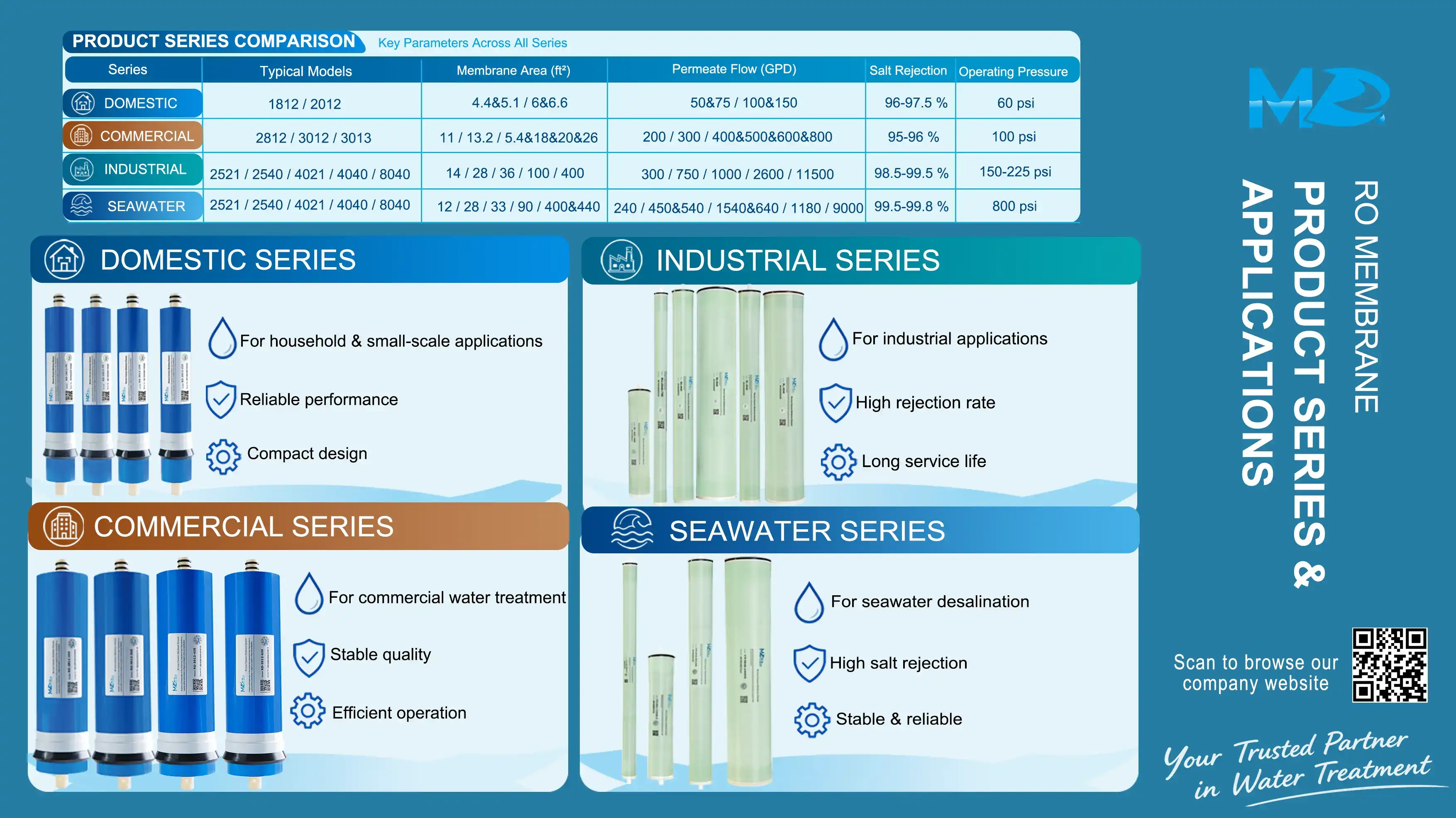
Single-Pass Seawater Desalination: From Theoretical to Orderable in October
Toray announced in June 2026 that its TSW-K/M/V series seawater RO membrane elements will launch commercially in October, with a showcase at Singapore International Water Week. The headline figure: salt permeability up to 55% lower than the existing TM820M/TSW-M models. According to Toray, this enables new seawater desalination projects to shift from the conventional two-pass RO configuration to a single-pass process.
For owners planning new capacity, this means the capital cost and specific energy consumption models need to be rerun. Single-pass RO eliminates not only a second-stage high-pressure pump and membrane array, but also the associated piping, instrumentation, and maintenance labor. For existing two-pass systems, replacing first-pass elements with higher-rejection membranes reduces the salinity load on the second pass, allowing operators to either lower second-pass operating pressure or improve overall recovery while maintaining permeate quality.
Boron rejection is the other critical metric. The series delivers typical boron rejection of 94–96% under test conditions of pH 8 and 5 mg/L feed boron. This directly addresses the tightening of drinking water and industrial water quality standards. The improved chemical resistance is expected to limit membrane performance degradation during repeated alkaline and acidic cleaning cycles—an economically meaningful attribute for seawater plants with elevated cleaning frequencies.
Implication for specification: If you are conducting a process package comparison for a seawater project, single-pass RO merits a fresh feasibility review. For operating two-pass systems with elevated second-stage loading, first-pass membrane upgrade may be a more economical path than expanding second-pass membrane area.
The Membrane Boundary of ZLD: DuPont Pushes Concentration to 250 g/L
DuPont expanded the FilmTec Fortilife portfolio in April 2026 with the XC-Max UHP and XC220 low salt rejection RO (LSRRO) elements. The XC-Max UHP can concentrate brine to 250 g/L as NaCl at operating pressures up to 120 bar; the XC220 reaches 220 g/L at 83 bar. DuPont’s positioning is explicit: this capability extends membrane technology into operating regimes traditionally dominated by thermal processes, allowing the feed volume to the final evaporation step in conventional ZLD systems to be significantly reduced, and potentially bypassing evaporation altogether.
For industrial zero liquid discharge projects, this shifts the economic boundary of membrane preconcentration outward. Evaporator and crystallizer capital cost and steam consumption are the dominant cost centers in ZLD systems. If the membrane stage can push concentrate from the conventional 70–80 g/L range to above 200 g/L, the downstream thermal stage can be scaled down by an order of magnitude. The engineering requirements are not trivial: ultra-high-pressure operation demands matching high-pressure pumps, energy recovery devices, and concentrate-side scaling control strategies. This is not a drop-in element replacement.
Implication for specification: If an existing ZLD system has excessive evaporator loading and operating cost pressure, the membrane preconcentration route merits re-evaluation. Element selection must account not only for maximum operating pressure but also for the compatibility of ancillary high-pressure equipment and concentrate-side antiscalant strategy.
Fouling Control: From “Resist Deposition” to “Actively Remove”
Membrane fouling remains the most stubborn variable in RO operating cost. The 2026 research and product landscape shows attention shifting from passive surface chemistry toward active intervention.
Electroactive membranes represent one path. Researchers have integrated laser-induced graphene (LIG) into polysulfone support layers to create conductive thin-film composite membranes. Applying a small electrical potential enhances antifouling performance and enables electrochemical cleaning, shifting the membrane from passive resistance to active fouling mitigation. Salt rejection of 97.2% for Na₂SO₄ has been reported for optimized LIG-TFC membranes, though the technology remains at laboratory-to-pilot scale. The direction is clear: fouling control no longer relies solely on contact angle and surface charge optimization.
Reactive membranes represent another path. Embedding photocatalytic or Fenton-active nanomaterials within the polyamide layer generates reactive oxygen species in situ to oxidize organic and biological deposits. A 2026 review in the Journal of Industrial and Engineering Chemistry concluded that the economic viability of reactive membranes is overwhelmingly dictated by the magnitude of membrane lifespan extension—if self-cleaning capability does not meaningfully extend cleaning intervals or prevent irreversible fouling, the added nanomaterial cost is difficult to offset by operational savings.
At the commercial product level, Vontron released the PURO-ULD antifouling membrane in August 2026, employing an ultra-low pressure differential feed spacer design targeting industrial wastewater, mine water, and RO concentrate with high biological and organic fouling propensity. The core claim is reduced differential pressure growth rate and lower cleaning frequency—a pragmatic improvement through flow channel optimization rather than a disruptive self-cleaning mechanism.
Implication for specification: When a supplier claims “antifouling,” the distinction matters: surface chemistry modification, flow channel optimization, or a genuine active cleaning mechanism. The first two have commercially verifiable products; the latter requires pilot data. Specification should request cleaning interval extension data and post-cleaning flux recovery under actual feed conditions, not merely contact angle or zeta potential values.
A Procurement Logic Taking Shape
These three technical threads converge on a single conclusion: RO membrane selection is shifting from “compare salt rejection and flux” toward “compare application-specific fit.” Seawater projects need to ask about single-pass feasibility, boron rejection, and cleaning resistance. ZLD projects need to ask about ultra-high-pressure element compatibility with downstream thermal stages and concentrate-side scaling control. High-fouling applications need to ask about the specific mechanism of fouling control and verifiable operating data.
Xi’an Membrane Desalination International Co., LTD. supplies industrial-grade and seawater desalination RO membrane elements, with OEM and ODM support, complete testing capabilities, and a fast delivery system. For membrane selection discussion specific to your water quality or process scenario, contact us:info@md-desalination.com.