The 2026 RO Membrane Landscape: Why Contaminant-Specific Selectivity Is Replacing Salt Rejection as the New Benchmark
Introduction
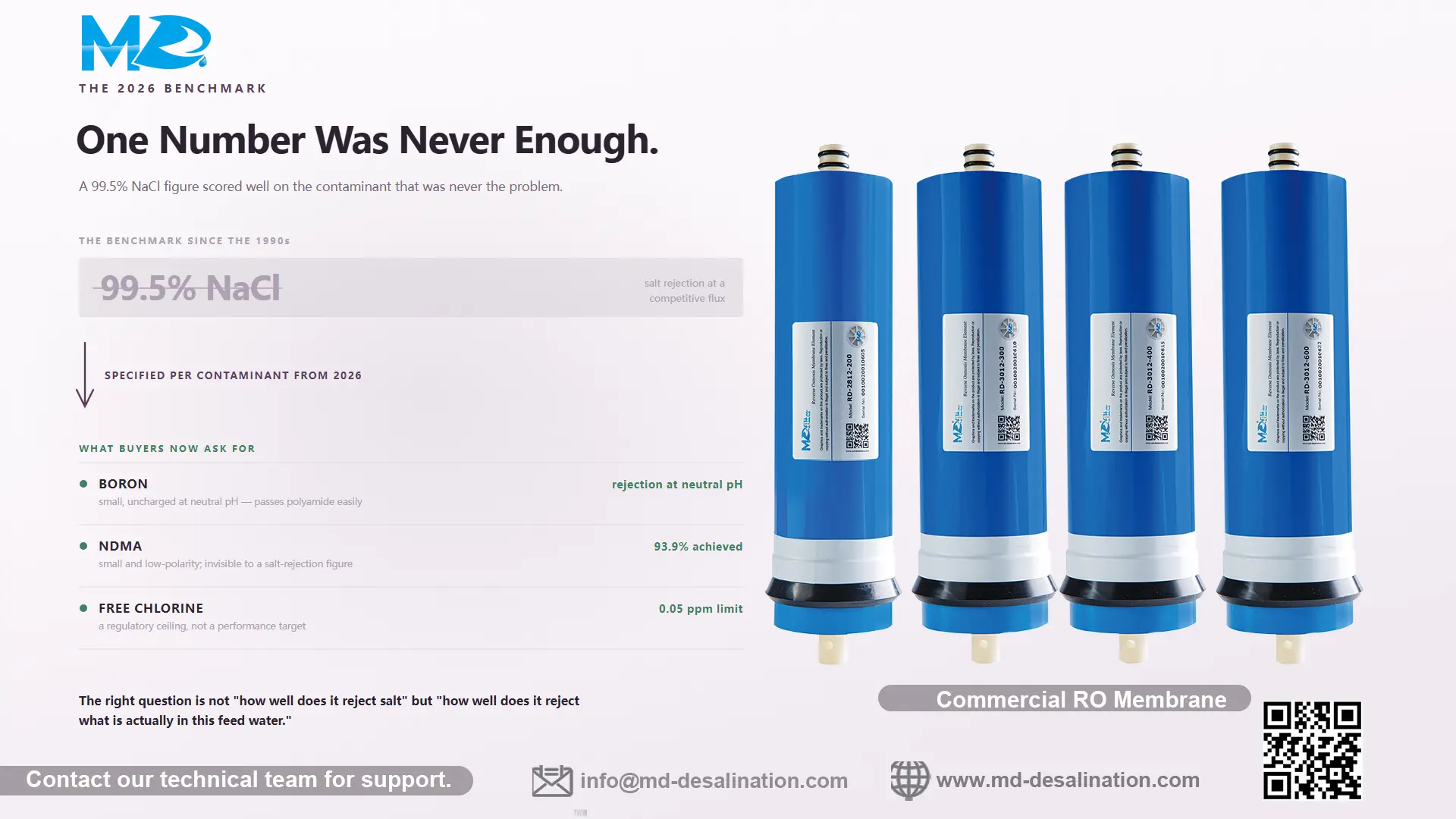
For decades, the reverse osmosis industry measured membrane performance almost exclusively by salt rejection and flux. A membrane that achieved 99.5% NaCl rejection at a competitive flux was considered “high-performance.” That benchmark is no longer sufficient.
In 2026, the global RO membrane market is valued at approximately $4.38 billion and is projected to reach $10.07 billion by 2035, driven not just by desalination capacity but by increasingly stringent regulations on trace contaminants, water reuse mandates, and industrial zero-liquid-discharge requirements. The membranes that will win the next decade are not necessarily the ones with the highest salt rejection—they are the ones engineered to reject specific, difficult contaminants that conventional polyamide chemistry struggles to address.
This article examines three developments reshaping RO membrane specification in 2026, and what they mean for engineers and procurement teams evaluating membrane performance.
Boron: The Desalination Bottleneck That Refuses to Move
Boron has long been the Achilles’ heel of single-pass seawater desalination. At neutral pH, boron exists as boric acid—a small, uncharged molecule that passes through polyamide active layers with minimal resistance. Conventional seawater RO membranes achieve only 40% to 70% boron rejection under standard conditions, forcing operators to rely on energy-intensive workarounds: caustic dosing to elevate pH, or a second RO pass.
Recent research is attacking this problem at the molecular level. A cryptand-enhanced polyamide membrane, incorporating three-dimensional cage-like molecules into the selective layer, demonstrated simultaneous improvements in water flux, salt rejection, and boron rejection. A 0.5 m × 1.1 m flat-sheet prototype maintained stable performance over 500 hours of real seawater testing. Separately, Toray’s upcoming TSW-K/M/V series, scheduled for October 2026 launch, claims salt permeability up to 55% lower than current models, enabling new desalination projects to shift from two-pass to single-pass treatment.
The commercial implication is direct: for seawater applications, boron rejection at neutral pH is becoming a procurement specification, not a premium feature.
NDMA and Trace Organics: The Water Reuse Challenge
As potable water reuse expands—driven by drought conditions in California, Singapore’s NEWater program, and China’s wastewater recycling initiatives—RO membranes face a class of contaminants that traditional salt rejection metrics do not capture. N-nitrosodimethylamine (NDMA) is a disinfection byproduct and probable carcinogen that is notoriously difficult to reject due to its small size and low polarity.
A 2026 breakthrough published in Nature Communications describes an ultraselective RO membrane incorporating hydroxy artificial water channels into the polyamide layer. Inspired by channel proteins in cell membranes, the membrane achieved 99.2% NaCl rejection and 93.9% NDMA rejection—surpassing the existing upper bound of permselectivity—while maintaining pure water permeance of 4.5 L·m⁻²·h⁻¹·bar⁻¹, exceeding state-of-the-art RO membranes.
For reuse projects where NDMA limits are tightening, this level of selectivity could eliminate the need for post-treatment with activated carbon or advanced oxidation, simplifying system design and reducing capital expenditure.
Regulatory Pressure: The Chlorine Tolerance Squeeze
Beyond performance, regulatory changes are reshaping membrane selection criteria. In May 2026, the U.S. EPA issued an emergency revision to its membrane reuse guidance, lowering the maximum allowable free chlorine exposure for RO membranes in municipal reuse applications from 0.10 ppm to 0.05 ppm. Effective July 1, 2026, all new RO membrane shipments into the U.S. must include third-party accelerated aging test reports compliant with ASTM D8349-23.
The practical impact is significant: Chinese membrane manufacturers exporting to the U.S. face mandatory batch-level requalification, extending lead times by 18 to 22 working days. For procurement teams, this means verifying batch-specific test readiness before order placement—and reassessing whether standard polyamide membranes offer sufficient chlorine tolerance for reuse applications.
What This Means for Membrane Specification in 2026
For engineers and procurement teams, three practical shifts emerge:
First, define rejection targets by contaminant, not by salt rejection alone. A membrane that delivers 99.5% NaCl rejection may still underperform on boron, NDMA, or specific trace organics. Request rejection data for the contaminants of concern in your feed water.
Second, verify regulatory compliance at the batch level. The EPA’s chlorine tolerance revision is a structural shift toward performance-based qualification. Suppliers who cannot provide ASTM D8349-23-compliant documentation for each batch introduce schedule risk.
Third, evaluate total system impact, not just element specifications. Single-pass boron rejection, NDMA selectivity, and chlorine tolerance all affect pretreatment design, chemical dosing, and post-treatment requirements. The membrane that reduces overall system complexity often delivers better lifecycle economics than the one with the highest isolated performance metric.
Conclusion
The RO membrane industry in 2026 is responding to a fundamentally different set of demands than a decade ago. Boron selectivity, trace organic rejection, and regulatory compliance are no longer academic research topics—they are procurement criteria for real projects. Membrane manufacturers that invest in contaminant-specific engineering are positioning themselves for the next wave of industrial water treatment growth.
At Xi’an Membrane Desalination International Co., Ltd. (MD), we manufacture high-performance RO and NF membrane elements for demanding industrial applications. Our technical team works with system designers to match membrane specifications to feed water chemistry and treatment objectives. Contact us at info@md-desalination.com to discuss your project requirements or request product samples.
References
1. SNS Insider. “Reverse Osmosis Membranes Market Estimated to Reach USD 10.07 Billion by 2035.” GlobeNewswire, May 2026.
2. “Hydroxy artificial water channels enable ultraselective reverse osmosis membranes for N-nitrosamine removal in water reuse.” Nature Communications, 2026.
3. “Cryptand-enhanced reverse osmosis membrane for efficient water desalination.” Chemical Engineering Journal, 2026.
4. Toray Industries. “TSW-K/M/V series reverse osmosis membrane elements.” CompositesWorld, June 2026.
5. U.S. EPA. “Membrane Reuse Guidance Addendum 2026-05: Chlorine Tolerance Revision.” May 2026.