The Rise of Zero Liquid Discharge (ZLD): How Advanced RO Membranes Are Meeting the Challenge
Introduction
As global industrial water regulations tighten, Zero Liquid Discharge (ZLD) has transitioned from a niche environmental concept to a strategic imperative for industries ranging from textiles to mining and power generation. ZLD systems are designed to eliminate wastewater discharge entirely, recovering valuable resources and minimizing environmental impact.
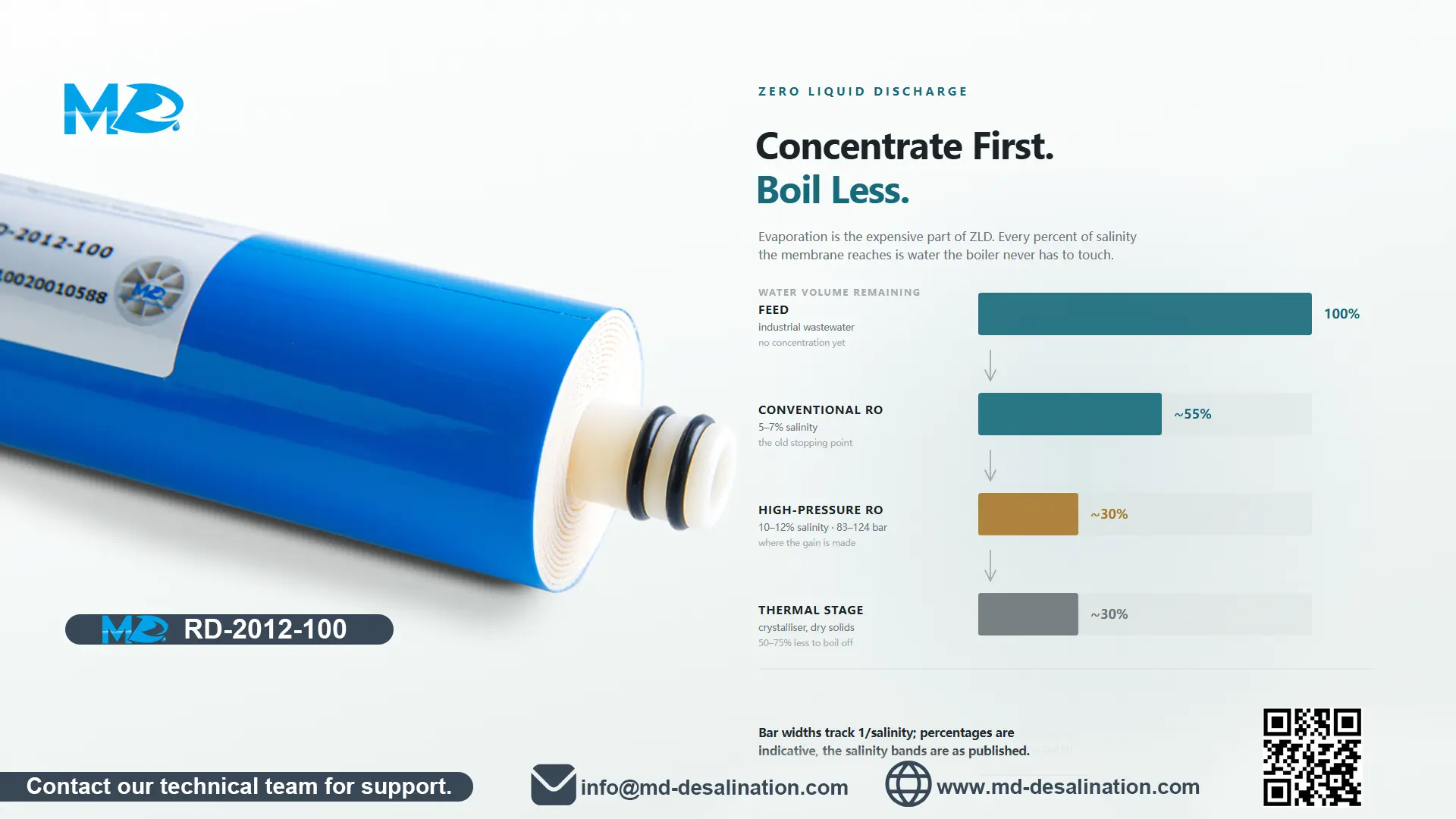
At the heart of every efficient ZLD system lies high-performance reverse osmosis (RO) technology. While thermal evaporation and crystallization handle the final stages, the RO membrane is the workhorse that preconcentrates the brine, drastically reducing the volume of water that must be boiled off. However, as salinity levels in the feed water rise, standard RO membranes begin to fail under extreme osmotic pressure. This is where advanced, application-specific RO membranes are changing the game.
The Bottleneck of ZLD: Extreme Osmotic Pressure
The fundamental challenge of treating high-salinity wastewater is osmotic pressure. As water is extracted through the RO membrane, the remaining concentrate becomes increasingly salty, making it harder for water molecules to pass through the membrane. When the osmotic pressure exceeds the membrane’s maximum operating pressure, water production drops to zero, forcing operators to rely on energy-intensive thermal processes.
Traditionally, ZLD systems relied on lower-pressure RO membranes to get the brine to about 5% to 7% salinity before handing it off to evaporators. To achieve higher concentrations and save more energy, the industry has developed high-pressure RO membranes (operating at 1,200 psi / 83 bar) and ultra-high-pressure RO membranes (operating up to 1,800 psi / 124 bar). These specialized membranes can push the concentration limits up to 10% to 12%, significantly reducing the thermal load.
Key Membrane Technologies for ZLD
To handle the fouling, scaling, and extreme pressures of ZLD applications, membrane manufacturers are deploying advanced polymer technologies:
1. High-Performance TFC Membranes: Thin-film composite (TFC) membranes with specialized surface modifications are required to maintain high rejection rates under extreme pressure. Enhanced smoothness and hydrophilicity reduce the adhesion of organic foulants and scaling minerals.
2. Disc Tube (DT) Modules: While not a membrane itself, the DT module design is critical for ZLD. By utilizing an open-channel spacer design, DT modules drastically reduce the risk of membrane fouling and scaling, making them highly effective for treating challenging industrial wastewater with high suspended solids prior to concentration.
3. Brine Concentration Membranes: Specially engineered to tolerate high concentrations of specific ions (such as silica or calcium), these membranes are designed for maximum chemical stability and structural integrity, preventing the element from collapsing under high differential pressures.
System Integration: The Key to Success
A high-performance RO membrane is only one part of the ZLD equation. The system architecture—specifically pre-treatment and pressure staging—is equally vital.
· Robust Pretreatment: Ultrafiltration (UF) and advanced chemical softening (such as using antiscalants or ion exchange) are mandatory to remove silica and heavy metals before the water reaches the high-pressure RO stage.
· Staged Configuration: In a typical ZLD process, the RO system is configured in multiple stages. Permeate from the first stage is often passed through a second RO stage for polishing, while the concentrate is fed to higher-pressure stages.
Economic and Environmental Impact
Investing in advanced RO membranes for ZLD delivers substantial benefits. By maximizing the concentration factor in the RO stage, the volume of water sent to the crystallizer can be reduced by 50% to 75%. Since thermal evaporation is the most energy-intensive part of ZLD, this reduction translates directly into massive savings in steam and electricity consumption. Furthermore, recovering clean permeate for reuse reduces the facility's overall freshwater intake, achieving true water circularity.
Conclusion
Zero Liquid Discharge is no longer just a regulatory checkbox; it is an opportunity for industrial plants to optimize their water cycle and recover valuable salts. The success of a ZLD system hinges on selecting RO membranes that can withstand extreme osmotic pressures and severe fouling conditions without compromising rejection rates. As the push for industrial sustainability accelerates, partnering with a membrane manufacturer that understands the complexities of high-salinity and ZLD processes is more critical than ever.
Optimizing Your ZLD System with MD Membranes
At Xi'an Membrane Desalination International Co., Ltd. (MD), we manufacture high-performance RO elements engineered for demanding industrial applications. From standard brackish water membranes to specialized high-pressure elements for brine concentration, our technical team can help you select the optimal membrane configuration for your ZLD project. Contact us at info@md-desalination.com to request product datasheets or to discuss your specific industrial wastewater challenges.
References
1. U.S. Environmental Protection Agency. "Zero Liquid Discharge (ZLD) Systems." https://www.epa.gov/
2. American Water Works Association. "Membrane Technology in Industrial Water Treatment." https://www.awwa.org/
3. Water Environment Federation. "Industrial Wastewater Management, Treatment, and Disposal." https://www.wef.org/