What Do RO Membranes Remove?
Reverse osmosis (RO) membranes are a crucial part of modern water purification systems, playing a central role in ensuring that water is free from contaminants and safe for use. Understanding what RO membranes remove helps clarify their value across applications, from household water filters to industrial processes.
This article examines the specific contaminants RO membranes can remove, how the process works, and why these membranes are essential for clean water. Xi'an Membrane Desalination International Co., Ltd. is a professional RO membrane manufacturer and supplier offering OEM and ODM services. For high-quality RO membranes, contact us at info@md-desalination.com to request free samples.
What Types of Contaminants Do RO Membranes Remove?
RO membranes are highly effective at removing a broad range of contaminants.
-
Dissolved Salts: RO membranes efficiently remove dissolved salts such as sodium, chloride, calcium, magnesium, and sulfates. These ions are larger than water molecules and are effectively rejected by the membrane's pores, producing desalinated water.
-
Heavy Metals: Contaminants such as lead, arsenic, cadmium, mercury, and chromium are effectively removed. These metals are typically present as dissolved ions or particulates, both of which the membrane can reject.
-
Organic Compounds: RO membranes remove a wide range of organic compounds, including pesticides, herbicides, petrochemicals, and volatile organic compounds (VOCs). These contaminants are generally larger than water molecules and are rejected by the membrane.
-
Bacteria and Viruses: Advanced RO systems with tightly controlled membrane pore sizes can effectively remove bacteria, viruses, and other microorganisms, although not all RO systems are designed for microbiological control.
-
Dissolved Gases: RO membranes can remove dissolved gases such as carbon dioxide and hydrogen sulfide, which contribute to taste and odor. These gases have a larger molecular size than water molecules and are therefore rejected.
-
Particulate Matter: The membrane filters out sediment, rust, and other suspended solids that can clog plumbing fixtures and cause cloudy or turbid water.
-
Nitrates and Phosphates: RO membranes remove elevated levels of nitrates and phosphates from agricultural runoff and wastewater, which can otherwise cause contamination issues in drinking water.
The membrane's effectiveness derives from its semipermeable nature, which allows water molecules to pass through while blocking larger particles and dissolved contaminants.
How Does the RO Process Work?
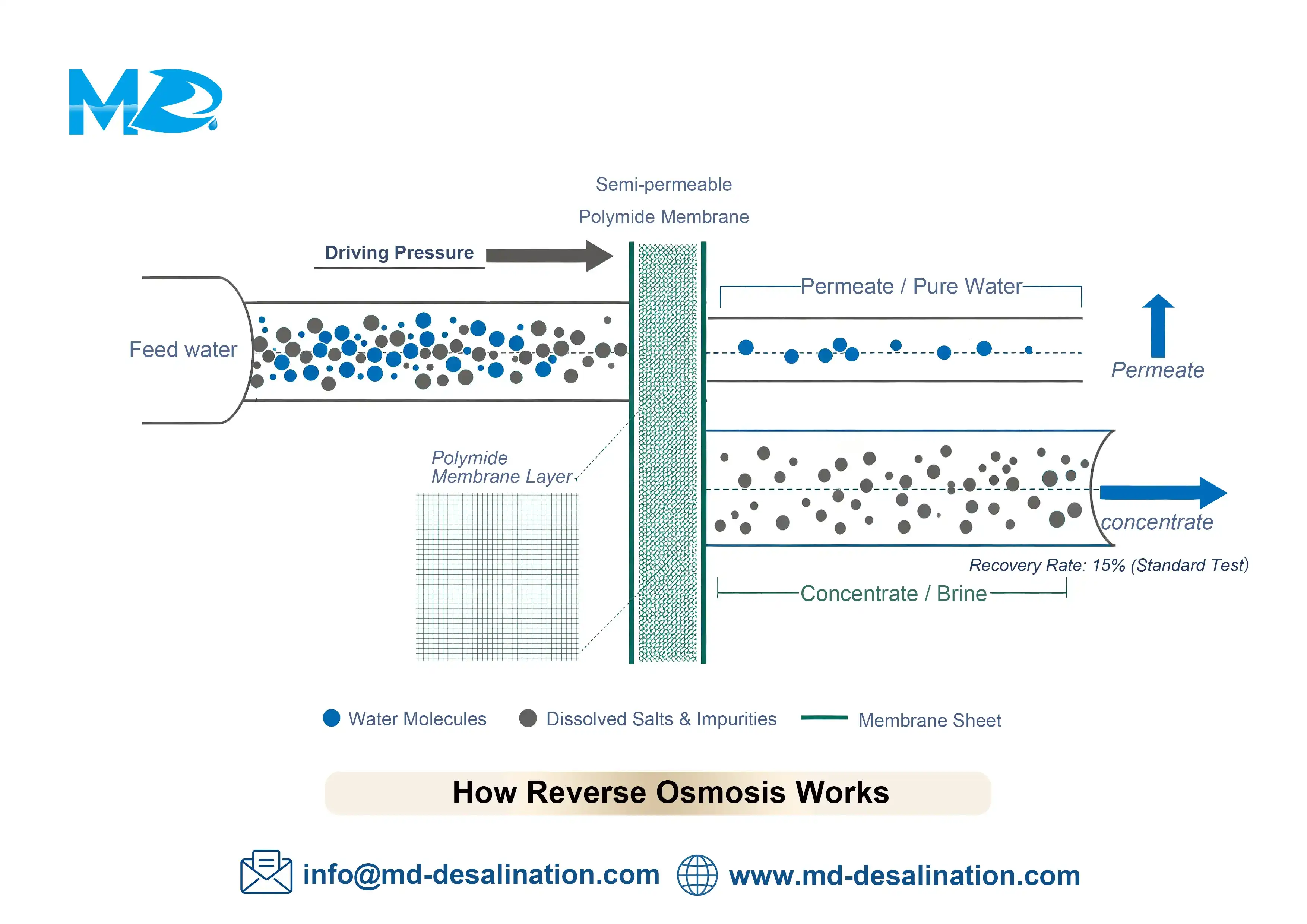
Reverse osmosis involves forcing water through a semipermeable membrane under pressure. The pressure pushes water through the membrane while leaving contaminants behind. The process proceeds in several stages:
-
Filtration: Water enters the RO system under pressure, typically provided by a pump. The pressure overcomes the osmotic pressure and pushes water through the membrane.
-
Semipermeable Membrane: The membrane allows water molecules to pass through its pores while blocking larger molecules and ions such as salts, heavy metals, and other contaminants. Pore size is critical in determining what passes through and what is rejected.
-
Separation: As water flows through the membrane, contaminants are separated from the water stream and collected as reject water (brine or concentrate), while purified water (permeate) passes through the membrane.
-
Product and Reject Streams: The purified water is collected as product water. A portion of the water that did not pass through the membrane is discharged as reject water, carrying concentrated contaminants away to prevent buildup.
-
Post-treatment: Some RO systems include post-treatment such as carbon filtration or UV sterilization to further polish water quality and ensure it meets drinking water standards.
-
Output: The system produces purified water with reduced levels of dissolved solids, contaminants, and particulates, suitable for drinking, industrial processes, or other applications.
Are RO Membranes Effective Against All Contaminants?
RO membranes are highly effective at purifying water, but they have limitations that require supplementary treatment for certain contaminants. Volatile organic compounds (VOCs), for example, are small-molecule organic chemicals that can pass through RO membranes and require additional treatment such as activated carbon adsorption. Similarly, while RO membranes significantly reduce bacterial levels, certain resilient microorganisms may require advanced disinfection techniques such as UV sterilization or ozonation.
Understanding these limitations is essential for designing comprehensive water treatment systems. Combining RO technology with appropriate additional treatments tailored to specific contaminants achieves the desired level of purification across applications, from residential drinking water to industrial processes.
How Often Do RO Membranes Need to Be Replaced?
The lifespan of an RO membrane varies depending on usage and water quality. Typically, membranes should be replaced every 2 to 3 years. Regular maintenance and water quality monitoring help determine when replacement is necessary.
Conclusion
RO membranes are indispensable for high-quality water purification. By removing a wide range of contaminants—including salts, heavy metals, microorganisms, and organic compounds—they ensure that water is both safe and pleasant to drink.
Xi'an Membrane Desalination International Co., Ltd. offers a range of high-quality RO membranes with large inventory, complete certifications, and OEM/ODM support. With strict packaging standards and fast delivery, we are committed to providing effective solutions for your water purification needs. For inquiries or to request free samples, contact us at info@md-desalination.com.
References
1."Reverse Osmosis (RO) Membrane Technology." Water Quality Association.
2."Understanding RO Membrane Filtration." National Sanitation Foundation (NSF).
3."RO Membrane Operation and Maintenance." American Water Works Association (AWWA).