What is the TDS of seawater reverse osmosis?
What Is the TDS of Seawater Reverse Osmosis?
Total dissolved solids (TDS) is the most direct measure of how well a seawater reverse osmosis plant is performing. Seawater arrives at roughly 35,000 mg/L of dissolved solids and has to leave the membrane at a level that meets a defined water quality standard. Understanding where those two numbers come from — and what sits between them — is what makes a seawater RO specification meaningful.
TDS in Seawater and in RO Permeate
Feed seawater TDS is typically around 35,000 mg/L, but the figure is not a constant. It varies with location and with the local balance of evaporation and freshwater input:
| Source | Typical TDS |
|---|---|
| Baltic Sea | 7,000–8,000 mg/L |
| Open ocean (global average) | 34,000–36,000 mg/L |
| Mediterranean Sea | 38,000–40,000 mg/L |
| Red Sea, Persian Gulf | 40,000–45,000 mg/L |
Feed TDS matters directly, because osmotic pressure — and therefore the operating pressure the plant requires — rises with salinity. A plant designed for the Persian Gulf is not the same plant as one designed for the Baltic.
Typical seawater RO permeate is 200–500 mg/L TDS from a single pass, which corresponds to salt rejection of 99.0–99.5%. Higher-rejection seawater elements reach 99.6–99.8% and produce permeate at the lower end of that range.
For reference, the WHO drinking water guideline for TDS is 1,000 mg/L, with 600 mg/L often preferred on taste grounds. Single-pass seawater RO therefore meets drinking water standards comfortably.
Where lower TDS is required, a single membrane is not the answer. Industrial users — power plant boiler feed, semiconductor rinse water, pharmaceutical process water — often need TDS below 10 mg/L, and sometimes below 1 mg/L. That is achieved with a second RO pass followed by electrodeionisation or mixed-bed ion exchange, not by specifying a better membrane. The membrane sets the starting point; the treatment train sets the endpoint.
How RO Reduces TDS in Seawater
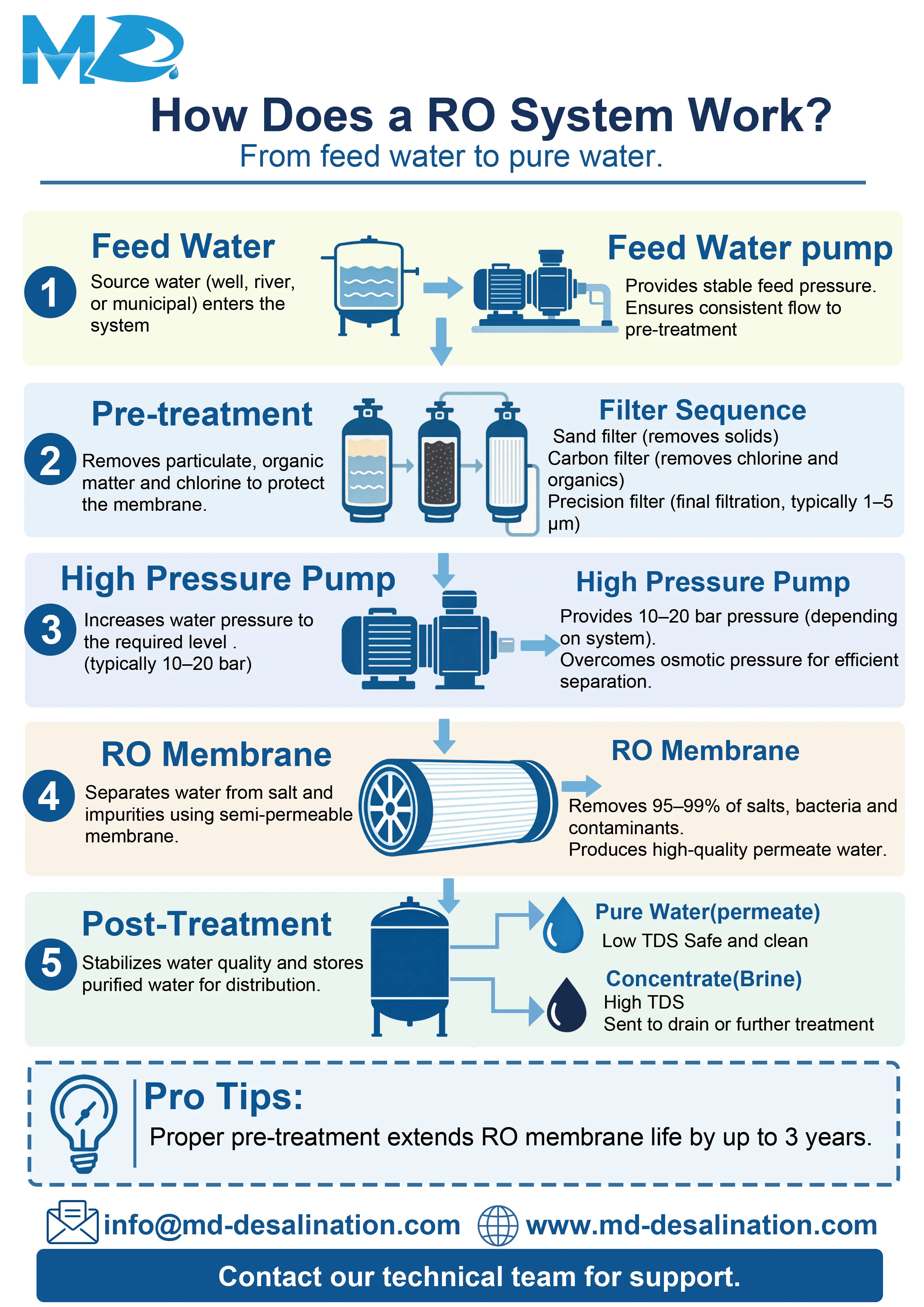
An RO system reduces TDS through a sequence of stages, each with a specific job.
Pre-treatment
Seawater passes through intake screening, media filtration or ultrafiltration, and cartridge filtration to remove suspended solids, debris and biological matter. Where chlorination is used to control growth in the intake, it must be followed by dechlorination — free chlorine destroys polyamide membranes above 0.1 ppm.
The purpose of this stage is not to reduce TDS. It is to prevent the membrane from being fouled or oxidized, which would cause TDS in the permeate to rise.
High-pressure pumping
Pre-treated seawater is pressurized to 800–1,200 psi and forced against semi-permeable polyamide membranes.
The pressure has to exceed the osmotic pressure of the feed — roughly 350 psi for seawater at 35,000 mg/L — before any permeate is produced at all.
Membrane filtration
Water molecules pass through the membrane while dissolved salts, minerals and other impurities are retained. The purified stream is called permeate; the stream carrying the rejected salts is called concentrate or brine.
Concentrate disposal
The brine stream leaves the system at roughly twice the salinity of the feed, and managing it is one of the principal environmental challenges in desalination. Common approaches include:
Surface water discharge through a diffuser array, designed to achieve rapid dilution
Deep well injection, where geology permits
Evaporation ponds, generally limited to arid sites with low brine volumes
Zero liquid discharge (ZLD), which recovers the remaining water and produces a solid salt, at a substantial energy and capital cost
Post-treatment
Permeate from seawater RO is aggressive and low in minerals. Post-treatment adjusts pH, remineralizes the water — commonly by dosing lime or carbon dioxide with calcite contactors — and brings it within the required distribution or process specification.
What Determines the Permeate TDS You Actually Get
Several factors move the permeate TDS figure, and only some of them are under the operator's control.
Feed TDS and composition. Higher salinity means higher permeate TDS at the same rejection rate.
Membrane salt rejection. The primary design variable — 99.0% versus 99.7% rejection is a large difference in the finished water.
Operating pressure. Higher net driving pressure increases both permeate flow and rejection.
Feed temperature. Permeate TDS rises as temperature rises, because solute passage increases faster than water passage. Seawater RO performance is quoted at a reference temperature, commonly 25 °C, and must be normalized for the actual site temperature.
Recovery rate. Higher recovery concentrates the feed as it passes through the array, raising the average osmotic pressure and the permeate TDS. Seawater systems are held to 35–50% recovery partly for this reason.
Membrane condition. Fouling, scaling and oxidation all raise permeate TDS. A rising TDS trend at constant operating conditions is the earliest reliable sign that something is wrong.
Can RO Remove All Types of Dissolved Solids?
No. RO removes most dissolved solids very effectively, but rejection varies by species, and it is worth being precise about why.
Ions are rejected primarily by charge, not by size. The polyamide active layer carries a negative surface charge and rejects dissolved ions through a combination of charge repulsion and differences in diffusion rate. This is why RO rejects sodium and chloride at 99% or better — monovalent ions are among the species it handles best, and they make up the bulk of seawater TDS. Claims that sodium and potassium pass through RO membranes because they are "small" are incorrect; if they did, seawater desalination would not work at all.
Small uncharged molecules are the genuine limitation. Dissolved gases such as carbon dioxide pass through readily, because they carry no charge and are not rejected by the mechanism above. This is why permeate pH is low and post-treatment is required. Boric acid behaves similarly: boron rejection is materially lower than salt rejection, which is why seawater plants raise feed pH to around 10 or add a second pass where boron limits apply.
Neutral organics of low molecular weight are also poorly rejected, and some volatile organic compounds pass through. These are normally managed upstream rather than by the membrane.
What RO does remove well: dissolved salts, heavy metals, hardness ions, bacteria and viruses, and larger organic molecules.
FAQ
Q: What is the TDS of seawater before and after reverse osmosis?
A: Feed seawater is typically around 35,000 mg/L, ranging from 7,000–8,000 mg/L in the Baltic to 40,000–45,000 mg/L in the Red Sea and Persian Gulf. Single-pass seawater RO produces permeate at 200–500 mg/L TDS, which meets the WHO drinking water guideline of 1,000 mg/L. Lower TDS requires a second RO pass and polishing, not a different membrane.
Q: How does RO reduce TDS in seawater?
A: Seawater is pre-treated to protect the membrane, pressurized to 800–1,200 psi, and forced through a semi-permeable polyamide membrane. Water molecules pass through; dissolved salts are retained and leave the system as concentrate. The permeate is then post-treated to adjust pH and restore minerals.
Q: What factors affect how well RO reduces TDS?
A: Feed salinity and composition, the membrane's salt rejection, operating pressure, feed temperature, recovery rate and membrane condition. Permeate TDS rises with feed temperature and with recovery rate, so performance figures must be normalized to a reference temperature before they are compared.
Q: Can RO remove all types of dissolved solids?
A: No. RO rejects dissolved ions very effectively — including sodium, potassium and chloride, which are removed at 99% or better. The genuine limitations are small uncharged species: dissolved carbon dioxide, boric acid and some low-molecular-weight neutral organics pass through more readily. Those are handled by pH adjustment, a second pass or upstream treatment.
Conclusion
Seawater arrives at the membrane at roughly 35,000 mg/L TDS and leaves it at a few hundred. That reduction is what makes RO the dominant desalination technology, and the gap between feed and permeate TDS is what a seawater membrane specification is really describing.
Reaching a lower TDS figure is a system design question rather than a membrane question. Pretreatment protects rejection, operating conditions determine it, and where very low TDS is required, a second pass and polishing step do the rest.
MD Desalination is a manufacturer and supplier of RO membrane elements, offering OEM and ODM services for domestic, commercial, industrial and seawater applications. We maintain large inventory, hold complete product certifications, support sample testing, and ship with strict packaging controls. To discuss your seawater membrane requirements, contact us at info@md-desalination.com.