Why Is Membrane Selection Critical for Modern RO Systems?
A Guide to Performance and Longevity
Introduction
As global water scarcity intensifies, reverse osmosis technology has become a cornerstone of industrial and municipal water security. Recent reports indicate that 75% of the global population resides in water-insecure areas, with 4 billion people facing severe scarcity at least one month per year. This reality has driven rapid adoption of RO systems across desalination, ultrapure water production, and wastewater reuse. However, the performance and lifespan of any RO system ultimately depend on one critical component: the membrane element. Selecting the right membrane is no longer a routine procurement decision—it is a strategic investment in operational efficiency and long-term reliability.
Understanding the Role of the Membrane Element
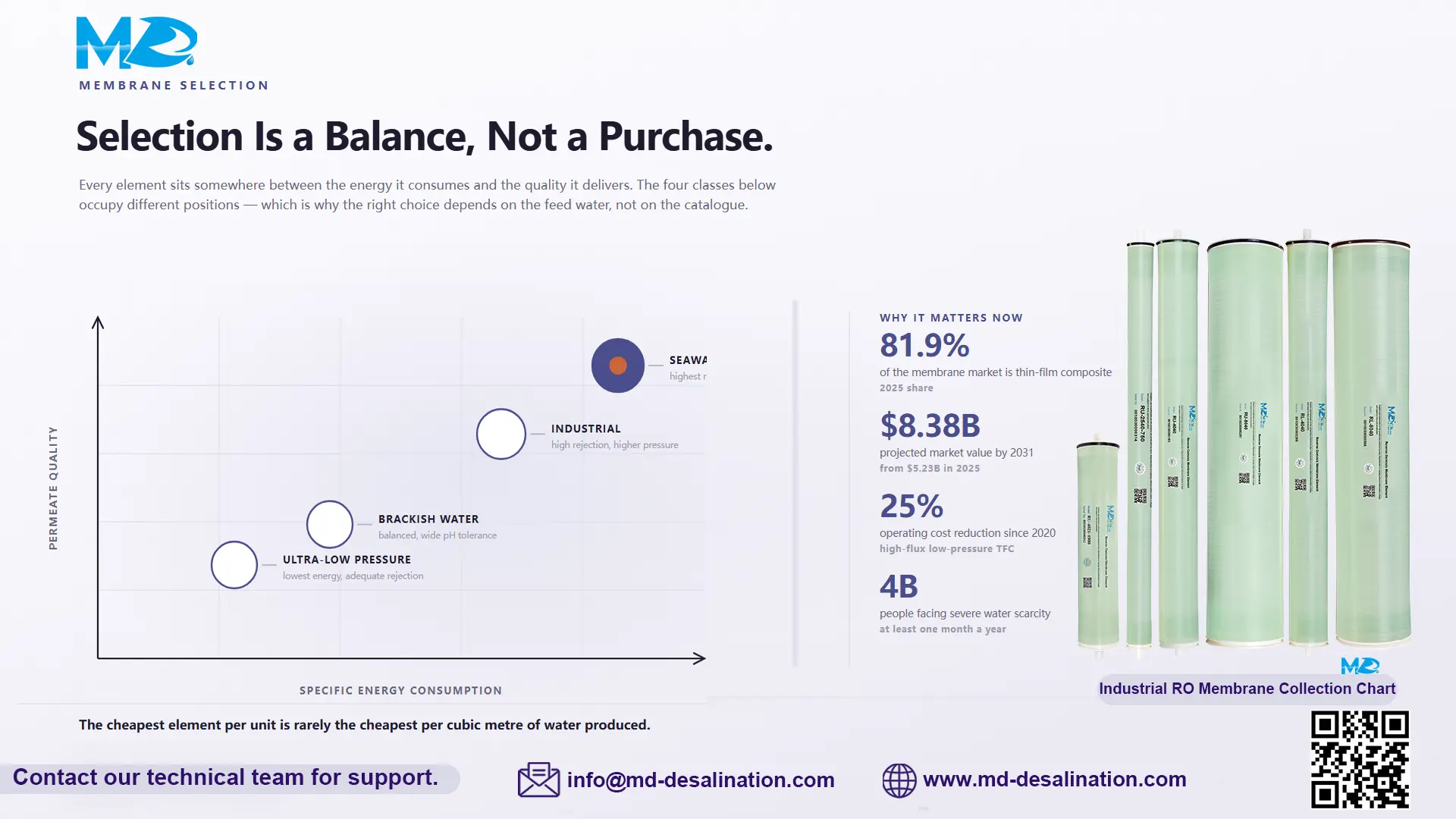
The RO membrane acts as a semipermeable barrier that allows water molecules to pass while rejecting dissolved salts, organic compounds, and microorganisms. In thin-film composite (TFC) membranes, which captured approximately 81.9% of the market share in 2025, a polyamide active layer is deposited onto a porous support substrate. This construction enables salt rejection rates exceeding 99.5% while maintaining high water flux. However, membrane performance is not static. Over time, fouling, scaling, and chemical degradation can compromise rejection efficiency and increase energy consumption, making membrane selection and maintenance critical to system economics.
Key Factors in Membrane Selection
Choosing the appropriate membrane for a specific application requires balancing multiple performance parameters. First, salt rejection rate determines the quality of permeate produced; for seawater desalination, rejection rates above 99.7% are typically required, while brackish water applications may tolerate slightly lower values. Second, permeate flow rate directly affects system capacity and capital cost. Higher-flux membranes can reduce the number of elements required, but they may also be more susceptible to fouling. Third, operating pressure influences energy consumption; ultra-low-pressure membranes can significantly reduce pump energy demands while maintaining adequate rejection. Finally, chemical compatibility and fouling resistance must be evaluated against the specific feed water chemistry. For industrial applications with variable feed quality, membranes with enhanced fouling resistance and wider pH tolerance often deliver superior lifecycle economics.
Market Trends Driving Membrane Innovation
The RO membrane market is projected to grow from $5.23 billion in 2025 to $8.38 billion by 2031, driven by expanding desalination capacity and stricter industrial discharge regulations. Several technological trends are shaping membrane development. High-flux, low-pressure TFC sheets have reduced operating costs by approximately 25% since 2020, making RO more accessible for municipal utilities in emerging markets. Plasma-enhanced surface modification is being adopted to mitigate biofouling, extending intervals between clean-in-place cycles. Additionally, the push toward sustainability is driving interest in membrane recycling and PFAS-free synthesis routes. For system designers, these advancements translate into opportunities to reduce energy consumption, extend membrane replacement intervals, and improve overall system reliability.
Common Pitfalls in Membrane Deployment
Despite advances in membrane technology, several operational challenges persist. Fouling and scaling remain the most frequent causes of premature membrane failure. Inadequate pretreatment—whether insufficient sediment filtration, missing antiscalant dosing, or ineffective chlorine removal—accelerates degradation and increases cleaning frequency. Another common issue is operating membranes outside their recommended pressure or temperature ranges, which can cause irreversible compaction or chemical damage. Finally, improper storage and handling during installation can compromise membrane integrity before the system even begins operation. Addressing these factors through proper system design, pretreatment, and operator training is essential for maximizing membrane lifespan.
Maximizing Membrane Performance and Longevity
Extending membrane life requires a proactive approach. Regular monitoring of normalized permeate flow, salt passage, and pressure drop provides early warning of fouling or degradation. When cleaning is necessary, using the correct chemical cleaning protocol for the specific foulant type—alkaline for organic fouling, acidic for mineral scaling—prevents damage to the polyamide layer. For systems operating on challenging feed water, incorporating appropriate pretreatment such as ultrafiltration or activated carbon can significantly reduce membrane loading. Additionally, selecting membranes with verified performance data and comprehensive certifications ensures that the product delivered matches the specifications required for reliable operation.
Conclusion
Membrane selection and maintenance are not peripheral concerns—they directly determine the efficiency, reliability, and total cost of ownership of any RO system. As water treatment demands continue to rise, partnering with a membrane manufacturer that offers consistent quality, technical support, and application-specific solutions is essential. Whether for desalination, industrial purification, or wastewater reuse, the right membrane delivers measurable returns through reduced energy consumption, fewer replacements, and dependable water quality.
Need professional advice on RO membrane selection?
At Xi’an Membrane Desalination International Co., Ltd., we manufacture high-performance RO membranes for diverse applications. Our technical team can help you select the optimal membrane for your specific feed water conditions and operational requirements. Contact us at info@md-desalination.com for product specifications, free samples, or OEM inquiries.
References
1. UNCCD. “Global Water Bankruptcy Report 2026.” https://droughtclp.unccd.int/ru/node/4630
2. Mordor Intelligence. “Reverse Osmosis Membrane Market Size, Share & Trends Analysis Report.” https://www.giiresearch.com/report/moi2114719/reverse-osmosis-membrane-market-share-analysis.html
3. Research and Markets. “Reverse Osmosis (RO) Membrane Market Global Report 2026.” https://www.researchandmarkets.com/reports/5790807/reverse-osmosis-ro-membrane-market-report